Photobucket

Πέμπτη 13 Μαΐου 2010

Sid Meier's Pirates

The original Sid Meier's Pirates! is one of the famed designer's most beloved games, which is saying a lot. After all, Meier is responsible for some of the greatest games ever made, most notably Civilization. Sid Meier's Pirates!, first published in 1987, is renowned to this day for its addictive blend of action, strategy, and role-playing. And the good news is, with this newly released remake, it's clear that Sid hasn't lost the magic touch. This new Sid Meier's Pirates! is an amazing, wonderfully lighthearted game that boasts an intoxicating blend of strategy and action, and as such it's a dire threat to your professional and personal productivity.


The Caribbean is brought to life vividly, thanks to the beautiful and colorful graphics.
In Sid Meier's Pirates!, you play as a pirate out for revenge against the evil Spanish nobleman who wronged your family. At least, that's your initial reason for going to sea. The beauty of Sid Meier's Pirates! is that this open-ended strategy game lets you live the glorious life of a swashbuckler your own way. You can pursue the career of a privateer, a treasure hunter, an explorer, or a trader. More often than not, you'll dabble in all those fields at the same time. You'll sail the Spanish main, trade broadsides with other ships, engage in dashing swordfights, search for buried treasure, sneak into hostile towns, and dance with many a governor's daughter along the way. Your character will age over time, so your ultimate goal is to amass as much fame and fortune as possible before you retire, at which point your pirate will go into the hall of fame and you can start all over again.

The game's prologue explains how your wealthy merchant family was imprisoned and how you escaped as a young boy. Now, years later, it's up to you to save your family, vanquish the evildoers, and get rich along the way. The first thing you'll do is choose a name for yourself, as well as a specialty, such as sword fighting (which is useful in duels), navigation (which makes you sail a bit faster), or wit and charm (which help your dancing skills). You also select a nation to align yourself with, which determines which ports are friendly to you, as well as a time period, which affects the starting balance of power in the Caribbean. After that, you'll begin in your tiny ship in a great big sea that's alive with commerce and activity.

Sid Meier's Pirates! is remarkably easy to pick up and play (in fact, you can practically play the entire game without lifting your right hand from the numeric keypad on your keyboard), yet that simplicity belies a considerable amount of strategic depth. Your first stop will be in port, where you can pick up a letter of marquee from the local governor, which basically gives you the right to sink any ship not flying that nation's flag. You can also swing by the tavern to get the latest gossip (which can reveal useful info, such as the sailing of a treasure ship), purchase a useful item from the mysterious guy in the corner, or hire a bunch of scurvy knaves for your crew. After you check in with the shipwright, who patches up any damage and can upgrade various components of your ship, you'll visit the local merchant, where you can provision your ship and purchase or sell trade goods.

When sailing around the Caribbean, you can go anywhere, though you're limited by two constraints. The first is food. You can carry only so much food, and the bigger your crew, the faster your food will disappear. While this doesn't sound much of a problem, in an age when sailing voyages took weeks and even months, it becomes an issue quickly. Thankfully, you can always pull into a friendly port, or hijack a nearby vessel and commandeer its food. The other constraint is the morale of your men. Your salty crew members expect a fair share of the plunder when the voyage is over, and you'll have to keep them happy by bringing in the income--otherwise they'll start to desert you in droves.
What makes Sid Meier's Pirates! so compelling, though, is its exquisite pace. There's just so much for you to do when you're sailing about the Caribbean, and you're never too far from accomplishing some kind of goal, whether it's finding the final part of an important treasure map or chasing down some dastardly nobleman who wronged your family. This pacing makes it easy to get drawn into the game and even harder to stop playing--you may well discover yourself looking up from the game and realizing that you've spent the entire night playing. At the heart of the game is the sense that it's essentially a series of enjoyable, fast-paced minigames stitched together. In the span of half an hour, you can easily wage several ship battles, dance with numerous governors' daughters, sneak into an enemy port, and dig up a stash of buried treasure.


Battles involve using the wind to maneuver yourself into position and then unleashing a powerful broadside.

When your ship engages in battle, the game zooms in on the immediate patch of ocean (including any nearby landmasses, rocks, and shoals) and you have to maneuver into position and then fire broadsides at the enemy. These battles last only a couple of minutes at the most, but there's a great deal of tactical depth to them, particularly at the harder difficulty levels. Not only is the enemy more cunning at harder levels, but you must also factor in the constantly shifting wind, which affects your ship's maneuverability. Ideally, if you're upwind of an opponent (which is called "having the weather gauge") you can control the battle. And to capture a ship, you must use different ammunition, including medium-range chain shot to destroy sails and rigging and short-range grape shot to whittle down the opposing ship's crew. That last one is the most important, because if you try to board a ship, there's a chance you'll have to fight its captain in a duel, triggering the sword-fighting minigame. Defeat the captain and you can capture the ship and sail it into the nearest port, where you can sell it and its cargo for a profit and then pay a visit to the governor for your reward. You may also have the opportunity to dance with his daughter, and if you charm her, she may reward you with a valuable piece of information. You'll then go out to sea to repeat the cycle all over again.

Perhaps the most difficult minigames involve sword fighting and dancing, due to the fact that they rely on fast reflexes. (This can be tough, especially since some strategy fans aren't used to twitch-based games.) To keep things simple, sword fights are highly scripted in the sense that they all unfold the same way. During a bar fight, for instance, if you're winning, you'll always knock your opponent off the balcony, and if you're losing, he'll always chase you back up the stairs. Push him back far enough and the barmaid will break a bottle over his head, knocking him out. The only thing you have to worry about is timing the right swing at the right moment, and parrying or dodging his swings. Meanwhile, during a dance, you have to quickly respond to the dance cues that your partner gives you, or else you'll stumble and mess up. While both sword fighting and dancing can be difficult at first, they get much easier once you learn to recognize the patterns. Plus, you can purchase or acquire special items to make both minigames easier, such as a superbly balanced sword that lets you swing faster or dancing slippers that give you more time to react to a cue.

Charm a lovely governor's daughter by dancing well and she'll reward you with something valuable.

When you need to infiltrate a hostile port, you'll encounter the sneaking minigame, which is sort of Pac-Man in reverse. Your goal is to skulk around the mazelike streets of a town, avoiding the town watch. If captured, you'll be thrown into jail, where you'll rot for a few months before they let you go. At the easier difficultly levels, dodging the guards is incredibly easy, but at the harder levels, it's a lot tougher. Thankfully, you have a few moves at your disposal, such as the ability to scale walls, knock out guards from behind, and duck behind bales of hay to hide. The suspense can be high at times, especially when you narrowly weave between several guards.
Then there are the turn-based land battles that occur when you try to raid an enemy port or face off against the main bad guy at the end of the rescue-your-family storyline. In these, you have three kinds of units at your command: officers, sailors, and buccaneers. Officers and sailors are melee units, while buccaneers are armed with muskets. In battles, you have to maneuver your units to take advantage of the terrain and try to destroy or demoralize the enemy. You can flank enemies or use the jungle as cover. Win the battle, and you will not only plunder the town, but you'll also have the ability to switch its allegiance, thus earning you points with a particular faction.

The Caribbean of Sid Meier's Pirates! is a colorful place, and the game approaches the subject matter with a light touch. The pirates are charming rogues who like to sing drinking songs, the stuffy army officers are bombastic buffoons, and the ladies are all lovely. In other words, these are sorts of characters who would feel at home in an Errol Flynn movie or Pirates of the Caribbean. The game has a beautiful art style that's simple, clean, and packed with all sorts of graphical frills. The cotton sails on your ship softly glow in the warm sun, and beneath the glittery ocean water you can see dolphins and porpoises swimming in your ship's wake. The game's audio effects are also lighthearted and soothing, from the sound of water lapping against wooden hulls to the distant crack of cannons firing. Above it all is the game's wonderful soundtrack, which mixes historical tunes with memorable original themes. It also helps that the characters in Sid Meier's Pirates! speak in a sort of The Sims-like gibberish, which adds to the game's overall charm.


The map keeps track of all your accomplishments and failures, as well as the lovely ladies who have crossed your path.

Sadly, Sid Meier's Pirates! didn't make it out of the shipyard without a few flaws. The game suffers from some minor stability issues, which caused it to crash on one of our test systems every few hours. Thankfully, the game autosaves every time you enter port or battle, so you never lose much progress when it crashes. You can save the game manually as well, though you're not allowed to name saved games, which can cause a little confusion, especially when you have multiple characters.

There's also no multiplayer, which is a noticeable omission, since it would have been fun if you'd been able to go head-to-head against another player in the naval battles. Finally, the game is incredibly easy on the beginning difficulty levels, so you'll need to ramp up the difficulty level to find the appropriate level of challenge.

Nevertheless, this is still a completely engrossing strategy game that will easily consume countless hours. While the average pirate career might last only about 5 to 10 hours, there's tons of replay value here, as you can play on harder difficulty levels, try out different approaches, and check out different sailing eras. With its engrossing gameplay, impeccable pacing, and charming presentation, Sid Meier's Pirates! is quite simply one of the most enjoyable games to come out in years. 

Interview With a Captain of U.T.B.F

Ahoy Captain John Morris !

Please, spare some time and share with our fine and dear U.T.B.F. Brotherhood, some treasure from yer life, so as the Pirate Universe know ye better…

What is yer real name, mylord?

My name is Alkis Vasileiou

What are yer other, everyday activities, except from sailing, plundering and dreaming?

I'm a software engineer, writing code, like Java, C++ etc. Currently I 'm constructing web sites with Drupal, writing some Javascript and PHP. Also, another major activity is reading history, from Ancient Greece to Ancient Rome, from Dark Ages to Medieval times, Renaissance, Age of Discovery, Age of Enlightenment. Finally, I'm a fan of ambient music and post-apocalyptic fiction.

Describe yerself in 5-10 words

Nervous, anxious about the future and the unknown, a little bit selfish, but also creative and easy to sympathize (as others characterize me).

Since when ye got interested about Pirates?

Since I was playing with my playmobil pirate ship. But also, cause I read history, I found it interesting to read about pirate history.

What is this specific thing ye really like about Pirates most?

Their act of defying a system of absolute monarchies, risking their necks for freedom. The romance and the fierceness that surrounds them.

How ye decided to become a member of U.T.B.F. and what is that whispering in yer heart?

I decided to join the U.T.B.F. because I love pirate history, and U.T.B.F. shares that history that I found it interesting and exciting.

Why ye accepted to be a U.T.B.F. Captain?

I was honored to be accepted to be a U.T.B.F. Captain because the Captains saw my interest on pirate history. They saw my efforts to find as many parts as I can about pirate history that I will always try to find and share with my pirate Brotherhood.

What is yer favorite pirate weapon?

My favorite pirate weapon is the flintlock pistol

What is yer favorite pirate drink?

Time flies...when you are having rum!

What is yer favorite pirate song?

I don't have a specific song that I like the most, I like some soundtracks from various pirate movies and games as well as the Irish Rovers.

What is yer favorite pirate word or phrase?

Many, but I will stick to one...or two. “Where there is a sea there are pirates.” and “Life’s pretty good, and why wouldn’t it be? I’m a pirate, after all.”
What is yer favorite item in your pirate wardrobe?

The flag of U.T.B.F. brotherhood of course!

Ye feel rather a blessed or a cursed pirate figure?

I will leave that to the world, the world always decides.

Do ye believe that the pirates’ life is really fer ye?

With such a strong brotherhood as the U.T.B.F. team, certainly! 

Gramerci Captain fer yer time and thinking on this short interview. 

Τρίτη 11 Μαΐου 2010

THE THIRTY-FIRST OF AUGUST

THE THIRTY-FIRST OF AUGUST

(French trad.)

On the thirty-first of August
We saw approaching under sail
An English frigate
Cutting through the sea and the waves
In order to attack Bordeaux!

Chorus:

Let's drink a cup, la la, let's drink in two draughts,
To the health of truelovers;
To the health of the King of France,
And **** to the King of England,
Who has declared war on us.

The commander of the ship
Summoned his lieutenant:
"Lieutenant, do you feel able,
Do you feel strong enough
To board and take the Englishman?"

The proud and hardy lieutenant
Replied, "Yes, Captain;
Call all hands to their stations:
I shall hoist our colours,
Which will stay aloft, we swear it."

The master blew his whistle
To call all hands on deck:
All was made ready for the boarding,
Hardy topmen, proud sailors,
Brave gunners, wee cabinboys.

Turning our back to the wind as we came up,
I boarded her at her forepart;
With hatchet and grenade,
With pike, sabre and musketoon,
Quick as a flash I had her all in order.

What will they say of the great big tub,
In Brest, in London, and in Bordeaux,
That let its crew be taken
By a privateer with six cannon,
When it had thirty-six good ones!

Δευτέρα 10 Μαΐου 2010

Sloop

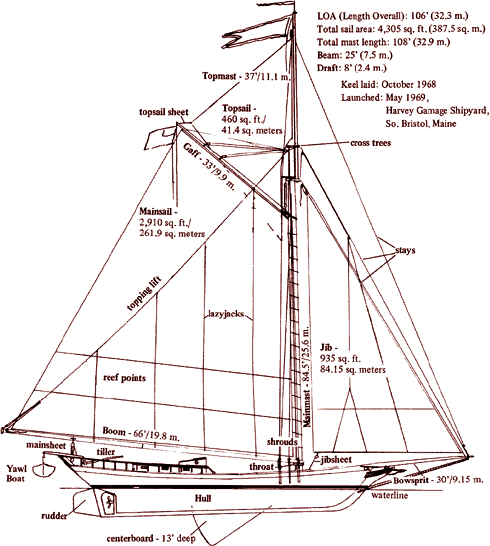
A sloop (from Dutch sloep) is a sail boat with a fore-and-aft rig and a single mast farther forward than the mast of a cutter. A sloop's fore-triangle is smaller than a cutter's, and unlike a cutter, a sloop usually bends only one headsail, though this distinction is not definitive; some sloops such as the Friendship Sloop have more than one. Ultimately the position of the mast is the most important factor in determining whether a ship is classified as a sloop.
On a gaff rigged, single masted boat, the clearest distinction between a sloop and a cutter is the run of the forestay. On the sloop, it runs to the outboard end of the bowsprit, which means that the bowsprit must always stay in position and cannot be retracted. On a cutter, the forestay runs to the stem head of the hull. This allows the bowsprit to be run back inboard and stowed. This can be helpful in crowded harbours or when stowing the jib in strong wind conditions.


Rationale behind the sloop rig

No design is perfect for all conditions; sloops are designed to optimize upwind sailing. However, sloops also offer an excellent overall acceptable compromise, if not optimal, to all points of sail. It is clear that the most difficult direction to sail is to the windward (known as sailing close-hauled); this requires some specific design features. The sail should be as vertical as possible to optimize the energy of the wind.
Two forces act on a vessel to push it from vertical (also known as heeling over): (1) the weight of the rig itself will tend to heel the boat, and (2) the sideways force of the wind on the sails. The sloop is a light rig with fewer lines and spars, and the sails on a sloop tend to be flat which minimizes sideways force when well trimmed. The heeling forces are also counterbalanced by the keel, which uses weight and hydrodynamics to offset the forces from the rigging and sails.
When sailing upwind, it is also important to minimize the drag of the wind on the sail and rig. A major cause of drag of the sail is a vortex of turbulent air generated by the top of the mast and sail. Secondary causes are non-optimal aerodynamic shapes of masts, stays and control lines. The sloop minimizes the drag of the tip-vortex with a high and narrow sail design (high aspect), maximizing the amount of sail for a given tip-vortex compared to a square-rigged or gaff-rigged ship. Also, the simplicity of the rig reduces the drag induced by control lines, masts and spars.


Sails carried

To maximize the amount of sail carried, the classical sloop may use a bowsprit, which is essentially a spar that projects forward from the bow of the boat. For downwind sailing, the typical foresail may be replaced (or sometimes supplemented) by larger curved sails known as spinnakers or gennakers. The typical foresail known as the jib, which does not overlap the mast more than 10 to 20 percent, may be replaced by a genoa, which overlaps the mast by as much as 55 to 100 percent for racing rules and sometimes more. The mainsail and Genoa form an efficient double wing.


The Bermuda Sloop

The modern yachting sloop is known as the Bermuda sloop, due to its Bermuda rig (also known as the Marconi rig, due to its resemblance to the wireless towers of Guglielmo Marconi), which is the optimal rig for upwind sailing; consequently sloops are popular with sport sailors and yachtsmen, and for racing. The rig is simple in its basic form, yet when tuned properly it is maneuverable and fast. The main disadvantage is the relatively large size of the sails, especially on larger vessels. It is also less successful sailing downwind; the addition of a spinnaker is necessary for faster downwind speed in all but the strongest winds, and the spinnaker is an intrinsically unstable sail requiring continual trimming.
The Bermuda sloop is a type of fore-and-aft rigged sailing vessel developed on the island of Bermuda in the 17th century. In this sense, the term applied to small ships, rather than boats. In its purest form, it is single-masted, although ships with such rigging were built with as many as three masts. Its original form had gaff rig, but evolved to use what is now known as Bermuda rig, making it the basis of nearly all modern sailing yachts. Although the Bermuda sloop is often described as a development of the narrower-beamed Jamaica sloop, which dates from the 1670s, the high, raked masts, and triangular sails of its Bermuda rig are rooted in a tradition of Bermudian boat design dating from the early 17th century. Part of that tradition included long, horizontal bowsprits, and large jibs. Three jibs were commonly used on Bermudian ships. Triangular sails appeared on Bermudian boats early in the 17th century, a development of the Dutch bezaan, or leg-of-mutton rig, itself derived from the Lateen rig. This became the Bermuda rig, and was appearing on Bermudian ships by the early 19th century. A large spinnaker was carried on a spinnaker boom when running down-wind.


Jamaican Sloop

Jamaican Sloops were slightly different from Bermuda Sloops, the largest difference being that these ships were built on the shores of Jamaica. The keel for Jamaica sloops would be usually between 50-75 feet, but could be built longer. They usually had a speed of around 12 knots, which is equivalent to about 13 mph.[1] The sloops were built near the shore and usually out of cedar trees since these were very resistant to rot, grew very fast and tall, and had a taste displeasing to animals[2] One of the reasons why Jamaican sloops were built out of cedar and not oak, was because of the specific properties of cedar. The oak that would normally be used would rot in about 10 years while cedar would last for close to 30 and was considerably lighter than oak.[2] The change in weight also made the ships made of cedar faster and able to maneuver quicker. Pirates found these ships very beneficial because they were able to sail in shallow areas where larger ships would either run aground or be unable to sail through at all. When the ship had to be careened, Pirates needed a safe haven in order to ground the ship. The shallow areas provided great protection from many of the naval ships of the English, since those tended to be larger and unable to safely sail in the shallow waters.[2] Since piracy was a nuisance in Caribbean waters, merchants sought ships that could be easily defended. The irony about these ships, though, is that, although the ships were needed to be fast and maneuverable in order to avoid pirates, if one of these ships was captured, that speed and maneuverability would be in the hands of the pirates.


Historic naval definition

The naval term "sloop" referred to ships with different rigs and sizes varying from navy to navy. "Sloop-of-war" was more of a reference to the purpose of the craft rather than the specific size or sailplan. (Further confusion was caused by the practice of redesignating a vessel simply according to the rank of the commanding officer.) The Royal Navy began buying Bermuda sloops, beginning with an order for three sloops-of-war (HMS Dasher, HMS Driver, and HMS Hunter, were each of 200 tons, armed with twelve 24 pounders) placed with Bermudian builders in 1795. They were intended to counter the menace of French privateers, which the Navy's ships-of-the-line were ill-designed to counter. Eventually, Bermuda sloops became the standard advice vessels of the navy, used for communications, reconnoitering, anti-slaving, anti-smuggling, and other roles to which they were well suited. The most notable examples of these were HMS Pickle, which raced back to England with news of the British victory and the death of Admiral Lord Nelson at the end of the Battle of Trafalgar, and HMS Whiting (79 tons and four guns), which lowered anchor in the harbor of Hampton Roads on 8 July 1812, carrying dispatches. The American privateer Dash, which happened to be leaving port, seized the vessel. The crew of the Whiting had not yet received news of the American declaration of war, and her capture was the first naval action of the American War of 1812. Generally a sloop was smaller than a frigate; however, in the later days of the U.S. Navy's sailing fleet, some of the largest vessels were called sloops because they carried fewer guns than a frigate, as few as 20. The classification of sloop was similar to a corvette.

source wiki

Κυριακή 9 Μαΐου 2010

Interview With a Captain of U.T.B.F

Ahoy Capitana ~Morgana del Sol~


Please, spare some time and share with our fine and dear U.T.B.F. Brotherhood, some treasure from yer life, so as the Pirate Universe know ye better…


What is yer real name, mylady?


My real name is Marianthi~Maya~Delezou. I am Greek.


What are yer other, everyday activities, except from sailing, plundering and dreaming?


I am a copywriter, mostly in advertising field, but also writing stories for kids and allegoric tales for adults. My other active side is performing on stage (acting, oriental dancing, choir singing, narrating) and another one behind the stage, organizing and promoting cultural events with friends artists.


Describe yerself in 5-10 words.


Tender, Imaginative, Creative, Stubborn, Anxious, Lazy, Romantic, Enthusiastic, Selfish, Faerie-wise…


Since when ye got interested about Pirates?


Since I very first watched some old pirate movies, as a teenager. Then the feeling got slept in me and woke up again when I gradually discovered so much talking about the universal, modern pirate dream in the web. Then actually thought “Maya, Mother Sea is calling… Follow your heart, lass!”


What is this specific thing ye really like about Pirates most?

The sense and the truth of freedom.


How ye decided to become a member of U.T.B.F. and what is that whispering in yer heart?


“Under the Black Flag” is maybe the most inspired and serious presence all over the web, sharing pirate history, without irrelevant, funny or silly stuff included, so as to gain followers. When I first saw some U.T.B.F. posts in F/B, I spotted the difference immediately. And of course, I became a fan at once, without a second thought. Since that day, almost a year ago, not just a whisper, but a large piece of my heart belongs to my pirate family, the U.T.B.F. Brotherhood...


Why ye accepted to be a U.T.B.F. Captain?

Because I was really honoured to be asked to, by the council of the U.T.B.F. Captains, who were surprised to meet a Greek lass who believes in the eternal pirate dream. So, since no wise pirate can reject such an honour and privilege, here I am, Capitana Morgana del Sol, always trying to keep firm and steady the romantic side of our brotherhood...


What is yer favorite pirate weapon?


The map! No reason to fight, if you don’t know where your destination is... Then comes the cannon. I just love the noise! (and the mess of course...)


What is yer favorite pirate ship?


The Carrack. A real ocean-going ship. Large enough to be stable in heavy seas, roomy enough to carry provisions for long voyages...


What is yer favorite pirate drink?


The black rum. Better be Captain Morgan.


What is yer favorite pirate song?


“Hoist the colors” by Hans Zimmer.


What is yer favorite pirate word or phrase?


“Be strong, me hearties!”


What is yer favorite item in your pirate wardrobe?


My black pirate belt. Loaded with a scull buckle full of tiny crystals.


Ye feel rather a blessed or a cursed pirate figure?


Somewhere in between. I leave this to the Universe to get the final decision.


Do ye believe that the pirates’ life is really fer ye?


This is something I will really know only when we really set sails with our brotherhood’s great ship “Arcadia”...


Gramerci Captain fer yer time and thinking on this short interview. Now, feel free to add anything you believe our noble Brotherhood would like to hear from you. Strong Sails!


“Me lads and lasses, me sisters and brothers, the whole world now, more than ever, is in need of the free spirit, the strength, the wealth and the romance of the pirate tribe. People need to dream, to get inspired, to share the love for freedom, to return to the primal innocence and the respect for the nature’s Elements. Eternal Pirate History has taught us all of this. Now, it is just in the reach of our hands to start this journey and make this dream an everyday truth, under the Black Flag!”


~Capitana Morgana Del Sol~

Παρασκευή 7 Μαΐου 2010

Αμερική και Πειρατές


Ενας Αμερικανός πλοίαρχος στα χέρια πειρατών. Ορισμένοι από τους πλέον πολυσύχναστους ναυτιλιακούς διαύλους στον κόσμο απειλούνται με επιθέσεις. Σκληροτράχηλοι άνδρες από μια ταραχώδη γωνιά της Αφρικής διαφεύγουν της σύλληψης και καταληστεύουν τις μεγάλες δυνάμεις του πλανήτη.
Αν και όλα αυτά ακούγονται γνώριμα, δεν αναφέρονται στην υπόθεση ομηρίας και την απελευθέρωση του πλοιάρχου Φίλιπς την περασμένη εβδομάδα, αλλά για τους Πολέμους της Μπαρμπαριάς, πριν από 200 χρόνια, εποχή κατά την οποία πειρατές από τις ακτές της Βόρειας Αφρικής (στο σημερινό Μαρόκο, Τυνησία, Αλγερία και Λιβύη) κυρίευαν ευρωπαϊκά πλοία, απαιτώντας λύτρα για την απελευθέρωση των πληρωμάτων τους.

Οι μέθοδοι
Ο καθηγητής Ιστορίας του Πανεπιστημίου Περντιού Φρανκ Λάμπερτ, εξηγεί πώς οι πειρατές εκείνοι -όπως και οι σύγχρονοι μιμητές τους στη Σομαλία- διατηρούσαν εν ζωή τους ομήρους τους, όχι από ανθρωπιστική διάθεση, αλλά από στυγνό υπολογισμό. Οι πειρατές κρεμούσαν ενίοτε θύματά τους σε τσιγκέλια ή τους έκοβαν σε μικρά κομμάτια εάν αντιστέκονταν. Οι πειρατές της Μπαρμπαριάς χρησιμοποιούσαν μικρά ξύλινα σκάφη, που κινούνταν συχνά χάρη σε δούλους κωπηλάτες, αλυσοδεμένους στα κουπιά τους, με τα οποία εφορμούσαν εναντίον μεγαλύτερων ευρωπαϊκών πλοίων. Οι μέθοδοί τους ήταν άκομψες αλλά ιδιαίτερα αποτελεσματικές, όπως και αυτές των σύγχρονων κουρσάρων της Σομαλίας, που πέτυχαν τον Νοέμβριο του 2008 να καταλάβουν σαουδαραβικό δεξαμενόπλοιο μήκους 300 μέτρων, χρησιμοποιώντας ένα και μόνο φουσκωτό σκάφος για να πλευρίσουν τον αργοκίνητο γίγαντα στον κρίσιμο δίαυλο του Μπαμπ ελ Μάντεμπ, στην έξοδο της Ερυθράς Θάλασσας.
Η τόλμη των πειρατών της Μπαρμπαριάς, όμως, υπήρξε η αιτία της καταστροφής τους, κάτι το οποίο οι Σομαλοί δεν θα πρέπει να ξεχάσουν. Σε άρθρο του 18ου αιώνα περιγράφεται η τακτική των πειρατών: «Αφού ορμήσουν στο κατάστρωμα εχθρικού πλοίου, κάθε ναύτης του πειρατικού κρατά μαχαίρι σε κάθε χέρι και ένα ακόμη στα δόντια. Η θέα τους προκαλεί τέτοιο τρόμο στα πληρώματα, που συνήθως παραδίδονται και εκλιπαρούν αμέσως», έγραφε ο Τόμας Τζέφερσον, ως πρεσβευτής των ΗΠΑ στη Γαλλία το 1786.
Οι πειρατές της Μπαρμπαριάς, όμως, διέθεταν επίσημη εκπροσώπηση χάρη στον πρεσβευτή της Τρίπολης -στη σημερινή Λιβύη- στο Λονδίνο. Οι πειρατές ήταν έτσι υποτελείς κυβερνητικού σχήματος (των βεζίρηδων «κεντίβ» της Τρίπολης), που τους διέταζαν να λαφυραγωγούν και να απαγάγουν ομήρους, απαιτώντας μέρος των κερδών. Τα πάντα διέθεταν επίσημη κάλυψη και χαρακτηρίζονταν από πλήρη διαφάνεια.

«Φόρος» και λύτρα
Αν μία δυτική χώρα πλήρωνε «φόρο», οι πειρατές του 18ου αιώνα δεν απειλούσαν τα πλοία της. Σήμερα, οι ναυτιλιακές εταιρείες πληρώνουν λύτρα, που μπορεί να φθάσουν μέχρι και τα 100 εκατ. δολάρια στους Σομαλούς πειρατές, μία στρατηγική που σώζει τα φορτία, αλλά προσελκύει παράλληλα άνεργους Σομαλούς ψαράδες στην «πειρατική επιχείρηση». Οι ΗΠΑ του 18ου αιώνα προσπάθησαν να εξευμενίσουν τους πειρατές της Μπαρμπαριάς, υπογράφοντας ακόμη και συνθήκες μαζί τους.

Δύο πόλεμοι
Η αμερικανική κυβέρνηση, όμως, δεν άντεξε άλλο να πέφτει θύμα στυγνού εκβιασμού και για τον λόγο αυτό προκάλεσε τους Πολέμους της Μπαρμπαριάς. Ο πρώτος, το 1801 συνέπεσε με την ορκωμοσία του Τζέφερσον στην προεδρία, ενώ ο δεύτερος το 1815 έδωσε την ευκαιρία στον πρόεδρο Μάντισον να αξιοποιήσει το ναυτικό για να βομβαρδίσει τις ακτές της Βόρειας Αφρικής.
Ιστορική ειρωνεία αποτελεί το γεγονός ότι η απελευθέρωση του πλοιάρχου Φίλιπς έγινε από το αντιτορπιλικό Μπέινμπριτζ, που βαφτίστηκε στη μνήμη ανθυποπλοιάρχου των Πολέμων της Μπαρμπαριάς.

«Κανένα έλεος από εμάς»
Σε βαρύ πονοκέφαλο για τον πρόεδρο Ομπάμα εξελίσσεται η έξαρση της πειρατείας στις ανατολικές ακτές της Αφρικής μετά την επεισοδιακή απελευθέρωση του Αμερικανού πλοιάρχου του κοντέινερ Maersk Alabama, Ρίτσαρντ Φίλιπς, δύο από τους Σομαλούς απαγωγείς του οποίου σκοτώθηκαν στη διάρκεια τολμηρής επιχείρησης την περασμένη εβδομάδα.
Παρά τη δέσμευση του Ομπάμα να παύσει τη δράση συμμοριών που καταλαμβάνουν όλο και περισσότερα πλοία στον Ινδικό Ωκεανό, παρά τις πρόσφατες επιτυχείς επιχειρήσεις διάσωσης ομήρων που πραγματοποίησαν οι ΗΠΑ και η Γαλλία, σκοτώνοντας συνολικά πέντε πειρατές, νέες πειρατικές επιθέσεις μετά τη διάσωση του Φίλιπς ανέβασαν τον αριθμό των αιχμαλώτων στα 300 άτομα, που κρατούνταν σε συνολικά 17 διαφορετικά πλοία στην περιοχή. Επιπλέον, οι Σομαλοί πειρατές ορκίζονται να εκδικηθούν για τον θάνατο των δικών τους και να σκοτώσουν οποιονδήποτε Αμερικανό κυρίως, ή και Γάλλο, πέσει στα χέρια τους... «Ψάχνουμε για Αμερικανούς και εάν τους πιάσουμε θα τους σφάξουμε», δήλωσε ένας Σομαλός 25 ετών.
Πράγματι, τη νύχτα της Τρίτης το αμερικανικό πλήρωμα του φορτηγού πλοίου Liberty Sun δέχθηκε επίθεση πειρατών με αυτόματα όπλα και χειροβομβίδες αλλά γλίτωσε την ομηρία και κατά πάσα πιθανότητα τον θάνατο όταν το πλοίο διέφυγε με κατεύθυνση την Κένυα και έχοντας υποστεί μικρή βλάβη. Νωρίς το πρωί της Τετάρτης δύναμη του γαλλικού ναυτικού επιτέθηκε στη «μητέρα» των πλοίων που έχουν καταλάβει οι πειρατές αποτρέποντας, σύμφωνα με το γαλλικό υπουργείο Αμύνης, άλλη κατάληψη σε βάρος πλοίου της Λιβερίας.
Εκείνο που έχει ενοχλήσει τους Σομαλούς πειρατές είναι η εκτέλεση των πέντε ανδρών τους, γεγονός που φαίνεται ότι εξέλαβαν ως κήρυξη πολέμου. «Θα κλιμακώσουμε τις επιθέσεις μας και την επόμενη φορά που θα αιχμαλωτίσουμε Αμερικανό ελπίζω να μην περιμένουν έλεος από μας», απείλησε αρχηγός συμμορίας στο σομαλικό χωριό Εϊλ, βόρεια του Μογκαντίσου. «Οι Γάλλοι και οι Αμερικανοί θα το μετανιώσουν που άρχισαν τους σκοτωμούς. Εμείς δεν σκοτώνουμε, παίρνουμε μόνο λύτρα», δήλωσε στο Ρόιτερ άλλος πειρατής.
Στην επιχείρηση διάσωσης του Φίλιπς χρειάστηκαν μόνο τρεις βολές ελεύθερων σκοπευτών, από απόσταση τριάντα μέτρων, για να πέσουν νεκροί οι τρεις απαγωγείς του πλοιάρχου. Οι δύο είχαν σκύψει τα κεφάλια τους έξω από τη σωστική λέμβο στην οποία επέβαιναν κι έτσι εκτέθηκαν στις σφαίρες, ενώ ο τρίτος «προσέφερε στόχο» από το παράθυρο.

πηγή Καθημερινή

Τετάρτη 5 Μαΐου 2010

Pirates of the Burning Sea


Pirates of the Burning Sea isn't World of Warcraft with swashbuckling. In fact, if we were forced to draw comparisons between Flying Lab Software's massively multiplayer role-playing game and another title, it would be EVE Online. Like EVE, Pirates is a complex game featuring an intricate supply-line economy--and like its galactic counterpart, its rewards aren't always immediate or obvious. No, it takes a while for the game to wriggle into your psyche. This isn't because the early hours aren't fun--they are--but because there's a bit of a learning curve to conquer before the pieces all fall into place. That might be enough to turn away players expecting immediate gratification, which is a shame, because Pirates of the Burning Sea is a special, and specialized, game that rewards you with some of the finest moments the genre has to offer.

Naval combat is exciting and strategic...

The year is 1720, and three nations are protecting their interests in the Caribbean while struggling with the constant threat of pirates (and one another). As you would expect, you'll align yourself with one of these entities--either Spain, France, England, or Pirate--and choose a profession. If you're a pirate, piracy is the only profession available, but aligning yourself with a nation opens up the naval officer, privateer, and freetrader professions. The style of play each profession favors is more or less obvious from its title: Officers excel on the high seas, privateers are talented adventurers, and freetraders serve as the backbone of the player-driven economy. Don't take this to mean that your role is as rigid as you would expect in another MMOG, though, since regardless of your profession, you can participate and succeed at all types of combat and trade. This is an important distinguishing feature, because you'll never need to pigeonhole yourself into a traditional RPG role.

Pirates eases you into its more sophisticated facets while keeping you entertained with a variety of well-designed quests, utterly fantastic sea battles, and somewhat disappointing ground combat. The basic questing structure doesn't offer anything unexpected: You chat with various non-player characters, receive a solo or group quest, and then travel to the necessary location to fulfill the task at hand. Sure, many of these are kill-this-and-deliver-that missions, but they stand apart from the usual generic mainstays thanks to well-written dialogue and common narrative threads that contribute to the game's overarching political tug of war. NPCs don't feature full speech, but the stories they relate in text when receiving quests lend them a good amount of character, from captains seeking revenge on their archenemies to drunken swains vicariously living off of your high-seas exploits.

You'll find yourself looking forward to completing quests that send you to sea, simply because battles in your ship are epic in scope and beautifully paced. An enormous vessel takes time to navigate across the undulating waves of the Caribbean Sea, but sea battles are leisurely enough to feel realistic while avoiding any feeling of sluggishness. Waging a sea battle is arguably the finest aspect of the game, as each tactical aspect of the battle demands your attention. You first need to be conscious of wind direction, as it dramatically impacts traveling speed. You also need to ensure your cannons are facing your target or you won't be able to fire them, but you also simultaneously need to protect each side of your ship from damage. Weighing your options in battle thus requires a good amount of finesse. Do you focus on maneuverability and turning speed to avoid damage at the expense of offensive prowess? Do you take the time to change ammo (a protracted task) and risk taking the cannon out of commission temporarily?

You can equip your ship with a variety of different ammunition, depending on whether you want to damage your opponent's sails, hull, or crew--and each type of damage benefits you and your group. This leads to some terrific team-oriented play, with one player focusing on slowing down enemy crafts with another diminishing crew numbers in preparation for boarding. Boarding is an early key to success in Pirates of the Burning Sea, though it focuses on the least interesting aspect of the game: hand-to-hand combat. You need to be close to an enemy ship and traveling at a slow speed to grapple it, and success isn't always guaranteed. Once you've grappled the enemy, however, you and your crew board the ship and participate in a somewhat messy melee that hardly caters to the game's strengths.

...but the boarding combat? Not so much.

Flying Lab certainly tried to add some punch to melee combat with the balance and initiative meters. More damaging attacks require balance, which is built up by performing relatively weak preparatory strikes, while finishing moves require initiative, which also builds up over time. There are also different schools of swashbuckling from which you can earn skills, such as dirty fighting and fencing. Yet these options, as interesting as they sound, can't rescue avatar combat. While ship combat finds just the right balance of deliberate pace and nail-biting excitement, melee battles move too slowly and look and feel dull. Some visual panache would have gone a long way toward spicing things up, but the lackluster graphics and sound of hand-to-hand combat will have you avoiding it whenever feasible.

Both types of combat fit into an overarching player-versus-player mechanic that's as awesome as it is intimidating. As you complete quests at certain ports, you also contribute to regional unrest, which results in a gradual breakdown of opposing national control. Once a region has become unstable enough, pirates can move in for the kill, creating PVP hot zones that make open-sea travel treacherous and further break down port control. After several days of real-time unrest, the original port owner and contesting nation battle it out in an epic 48-ship battle usually (but not necessarily) involving the players that contributed most to their nation during the contesting period. This is where each element of the game comes together in a glorious showdown that shines in contrast to the often lackluster PVP systems of its peers, and sets the bar for future MMOG designers. Your first gargantuan battle is likely to be one of your most memorable online gaming moments, featuring dozens of hulking ships attacking one another in a rollicking oceanic ballet. It's also a remarkably well-balanced structure in which players of any level and profession can make a difference, thanks to the unique features of ship combat. In a genre in which the best, most thrilling moments are generally reserved for top-level players, being able to see Pirates of the Burning Sea's finest feature without having to grind for a hundred hours is a breath of fresh air.

Once a nation has conquered enough territory, ports revert to their original owners and you do it all over again. Your reasons for capturing ports go well beyond simple national pride, however. Certain valuable resources are only available at particular ports, which makes being able to control them key to controlling the complex player-driven economy. Pirates of the Burning Sea falters a bit here, since learning how to take advantage of resources and port warehouses is a bit mind-boggling at first, and the manufacturing interface is hardly intuitive. Yet once you've got a handle on its intricacies, you can take advantage of them to rake in some serious cash, which can be used, in turn, to buy new ships or upgrade existing ones. You can also craft items out of raw goods and put them up for sale on the game's auction houses, which handily averages out standard prices for that particular item so that you can make an educated bid.

Unstable regions are best avoided unless you're prepared to fight.

Pirates of the Burning Sea has been, for the most part, stable during our testing period. However, it has suffered from its share of launch pangs and occasional lag, and throws some unnecessary obstacles into the mix. Even after a very recent patch, attempting dialogue with a few NPCs results in strings of code rather than actual dialogue. At other times, the game suffers from graphical bugs, ranging from texture load-in to missing geometry and disappearing water shaders. The general interface is also rather clunky, making it a hassle to identify quest locations, or even to manage chat channels. None of these factors make the game fare any worse than most other MMOGs during their initial launch periods, but they are drawbacks worth noting.

Though the game servers feel underpopulated, there's a good deal of community support for the game, best exemplified by content-creation options that allow players to create original flag and sail patterns, and then submit them for in-game use. We proudly created a flag and eagerly watched as other players voted on its quality. Sadly, taking advantage of this feature is limited to power users, since there are some stringent design requirements, and you will need to use a third-party graphical design program like Adobe Photoshop to create them. A simplified in-game creation system, like that employed in Guild Wars for capes, would have been a welcome feature, since it wouldn't exclude so many from participating in this interesting facet of the game. It's also worth noting that once you create your design, you still have to purchase it in-game in order to apply it to your own ships--an odd design choice indeed.

Aside from the aforementioned visual glitches, Pirates of the Burning Sea looks pretty good, if not exactly up to recent PC gaming standards, and the contrast between the tremendous marine battles and unspectacular ground combat translates somewhat into the visuals. The water is truly beautiful and surges convincingly when you are out at sea, which makes the unrealistic way in which it meets the shoreline stick out. Ship designs are also lovely, but player avatars are somewhat flat--though it's worth noting that you can dress them up in a variety of fun and interesting ways. Unfortunately, ports aren't much to look at and suffer from bland street and wall textures. In fact, while you'd think that a game taking place at such a colorful time in history would feature over-the-top animations, replete with swashbuckling deeds of derring-do, character models are stiff and lifeless. Overall, the game doesn't look bad, and it runs well on a variety of machines--it just doesn't meet the joy of its setting with an equally enthusiastic presentation.

Get used to grappling. It's often easier to take down a crew on foot than to sink their vessel.

The same can be said of the sound design, though it has its delights. Again, the dichotomy between ordinary landlubbing and oceanic exhilaration is apparent, with naval battles coming to life with the din of cannons and the warble of waves. On-foot combat is less interesting to hear, but the battle cries of your crew always are done well, even if they signal enthusiasm for a thrill that never arrives. The music isn't bad though, and exploring ports reveals minor delights, like a barside flute player entertaining patrons or a dockside fiddler providing some jaunty atmosphere.

If you're looking for an MMOG that offers instant rewards, you will probably find Pirates of the Burning Sea's learning curve daunting, but it's worth getting the hang of, because the game showers you with gifts the more you play it. Here is, finally, an online RPG that takes the grand-scheming economics and PVP of EVE and shrinks it into a manageable form, without forcing you to sacrifice the joy of exciting combat in the process. If you've been looking for something a little bit different and a lot more complex than the usual fare, you should give Pirates of the Burning Sea a good, hard look.

By Kevin VanOrd, GameSpot

Israel Hands

Israel Hands was second-in-command under Edward Teach (Blackbeard). Hands was given command of David Herriot's ship the Adventure after Herriot was captured by Edward Teach (Blackbeard) in March, 1718.


Israel Hands was with Edward Teach in the attack on Charleston, South Carolina. Afterwards, Hands settled with Teach in Ocracoke, North Carolina. When Teach was killed by Robert Maynard, Hands was captured and taken to Virginia for trial. In exchange for immunity, Hands testified against corrupt North Carolina officials who had consorted with Edward Teach.

According to Daniel Defoes ''General History of the Robberies and Murders of the Most Notorious Pyrates'', Hands is said to have died a beggar in London and also wrote that Hands was shot in the knee by Edward Teach after Teach fired at another member of his crew, striking Hands accidently. Hands supposedly asked Teach his meaning in this act, His response was, "That if he did not now and then kill one of them, they would forget who he was".

Τρίτη 4 Μαΐου 2010

The Pirate Island of Milos


After the occupation of Constantinople by the Francs, the Venetians took over the Aegean Islands. First came Mark Sanoudo who founded a dukedom of the Aegean Sea in 1207, centred in Naxos. This dynasty was in power until 1361. In 1268, the Miloans again showed their love of freedom when they rebelled against the Venetians, seizing Castro, in the hope that the Byzantine fleet would come to their aid. This, unfortunately, never happened and the rebellion was quashed with much spilling of blood by William I.

The Sanoudo dynasty was succeeded by the Krispon dynasty, and in 1566, Piali Pasha managed to complete Turkish control of the whole Cyclades area. The Sultan appointed a cunning Jew, Joseph Nazis, as the last Duke of the islands and he was authorised to collect a tribute of 14,000 ducats a year. His rule lasted until 1579 and he was represented by the lawyer Francisco Koronelo.

After the death of Nazis in 1580, the islands came under the direct rule of Sultan Mourat III with several political privileges. The islands were semi-autonomous with the obligation to pay «haratsi» (tax per head) to the Pasha Kapoutan, the Sultan’s delegate. It is worth mentioning that during all the years of Turkish rule, Milos was never occupied by the Turks but only visited by travellers and persons who came to inspect how the islanders lived.
Besides the Admiral, Pasha Kapoutan, a lawyer called Kadis came to settle the more serious differences between the islanders, often staying for long periods of time. The taxes were collected by the island committee and handed over to Pasha Kapoutan every two or three years.

Throughout these years of Turkish rule, there was frequent destruction and pillaging by the Venetians, the Turks and pirates. If the pirates did not rob the islanders, they stayed for long periods, to sell their booty.

A local pirate, John or George Kapsis, an experienced navigator with anti-Turkish persuasions, put himself in charge of a social rebellion and was named King by Kamili, the Catholic bishop of Milos. He reigned from 1675 to 1678 and he had such a great influence on his countrymen, that the Turks were obliged to sail to Milos and arrest him by fraudulent means. He was taken to Constantinople where he was hanged.

In the winter of 1771, Milos and the nearby islands were conquered by the Russians of Orlof. This continued until 1774 when the Turkish dominion was re-established.

During the same period, Hora, today’s Zefiria, was destroyed. The town which had grown from the Middle Ages, reached its zenith in the 16th and 17th centuries. However, in the middle of the 18th century the environment became increasingly inhospitable. Earthquakes, noxious gases escaping from the ground, floods and malaria, were the reasons that, by 1767, the towns-folk had fled and resettled in Castro and outside the castle walls in the area which is today’s Plaka. So it was that the beautiful, rich town with a population of 5,000 described in 1700 for us by the Frenchman, Joseph Pitton de Tournefort, was destroyed. In its place is today’s Zefiria, with just a handful of villagers.

Captain Godeke Wessels


Godeke Wessels was also known as Godeke Michels, after he married into the gender of Michaelsen of Dauelsen and acquired a residence in Eissel (Germany). Around 1400 it was a common practice for husbands to call themselves after the gender of their wife's family in order to keep the family crest, especially if it was a marriage with a rich daughter or a marriage into a well-known and important dynasty, such as the Michaelsens.

Godeke was known as an erudite man from a noble lineage, and he soon chose the life of a freebooter and helped the German Hansa during the war with Denmark to sack Danish ships and supply besieged German cities with food. During that time Godeke Wessels and Klaus Störtebeker often operated together as Vitalienbrόder in the North and Baltic Sea. After the war was over in 1395 Godeke and Störtebeker continued with piracy and captured not only Danish vessels but also ships of England, Holland and the German Hanse.

Due to his family relationships in the area of Pommern Godeke often used these locations as a hideout together with Klaus Störtebeker. There is proof that Godeke and Störtebeker donated 12 Himten units of rye and a ton of herrings to the poor folks of Verden (Lόneburg). However, the lion's share of this donation was later appropriated by the employees of the Verden Cathedral. This act of benefaction was highly unusual around 1400, and this probably is the reason why exactly this donation is passed down until today.

In March 1401 it was decided by the Prussian cities, that fleets should be sent into the Baltic Sea in order to bring the pirate operations of Godeke Wessels to an end. Thereupon Godeke sailed together with his companion Wigbold and a crew of 200 men to Norway. Angry about the escape of Godeke and Wigbold the German Hanse set the castle of Godeke's protector Chief Sibrands of Loquard on fire.

In April 1402 Godeke Michels was captured in the North Sea together with his crew, and they were all beheaded on the Grasbrook in Hamburg.

Κυριακή 2 Μαΐου 2010

Captain Abraham Blauvelt

Abraham Blauvelt was a Dutchman, instrumental in establishing several settlements and many places which still bear his name.
Blauvelt explored the coasts of Honduras and Nicaragua in the early 1630's. Afterwards, he went to England and with a proposal for a settlement a site in Nicaragua, which is near the town and river of Bluefields, Nicaragua. Blauvelt enlisted as a naval officer for the Swedish East India Company and by 1644 was in command of his own ship. He preyed upon Spanish shipping from Dutch New Amsterdam (New York ) and a harbor in southwest Jamaica which is still named Blewfields Bay.
After peace came once more between the Dutch and Spain in 1648, Blauvelt was no longer welcome in New Amsterdam. Blauvelt sailed to Newport, Rhode Island in 1649 to divy up his loot. The governor of Newport declared one prize illegal and Blauvelt's crew argued over the booty. Blauvelt was treated poorly at Newport. The local towns people were afraid that Blauvelt's piratical activities had permanently ruined the reputation of Rhode Island.
In 1650 Blauvelt was in command of another ship, the La Garse, a French ship. Later on along the border of Honduras and Nicaragua living among the Indians at Cape Gracias ΰ Dios. It was here that he heard of Sir Christopher Myng's plans to organize a raid on Campeche Bay in Mexico. In 1663 he joined with Myng and was an active participant in the raids. Nothing is known of him after this time.

Τρίτη 27 Απριλίου 2010

Captain William Parker


Parker was a member of the lesser gentry near Plymouth. In 1587 he sailed in consort with Sir Francis Drake during Drake's raid on Cadiz, Spain.
In the 1590's Parker sailed the West Indies taking several prizes. He also plundered Puerto Caballos in Honduras in 1594 & 1595.
After 1596, as owner of his own vessel, he partnered with Sir Anthony Sherley, but this relationship ended when after a time no prizes were taken. Leaving Sherley behind, Parker attacked Campeche, Mexico. Parker was wounded in the attack but survived & succeeded in capturing a frigate carrying silver which was en route to San Juan De Ulua.
Parker next captured Portobelo in February 1601. Portobelo was a very important port being the departure point from which Peruvian treasure left for Spain. Parker then sailed to Panama & plundered Saint Vincent in the Cape Verdes. He also captured & held for ransom the Cubagua pearl-boats & captured a Portuguese slave ship. His successes secured for him a prominent position in Plymouth, where he was looked upon as a hero of sorts & he became a founding member of the Virginia Company in 1606.
Parker was made Vice-Admiral & left on an expedition to the East Indies, but died at Java in 1617. 
William Parker, of Tortuga was able to take Porto Bello in 1602, less than one year after all of the fortifications were built. With a combined force of two ships, two pinnace, and two small shallops with 378 men. They entered Panama waters near the Gulf of Aclé and tried sailing west along the coast, but encountered strong winds, the kept driving him back. Leaving the bigger ships at Aclé, he continued with the pinnaces and shallops and 150 men. At the Island of Bastimientos, they captured some booty and took some Spanish prisoners along six Negroes as guides.
They entered the mouth of Porto Bello River on the 7th of February at about 2:00 AM with a full moon. He proceeded into the harbor in one of the shallops hoping to sneak past the defenses without being seen. The boat was spotted by the sentry at Fort San Felipe, and they shouted a challenge to the ship. Parker was prepared for this, and ordered one of the Spanish prisoners, while many guns were aimed at him, to answer back in Spanish, that they were a merchant ship from Cartagena. The sleepy guards, not being able to see well in the darkness, believed him and gave them instructions on were to drop anchor in the harbor near the town. As he approached the town, he was again challenged by the smaller Fort San Jago and ordered to stop. They dropped anchor, and the pirates disembarked, going to the suburbs, in a area known as Triana. Here he set all of the buildings on fire and marched into Porto Bello, to the king's Treasure House and attacked it.
With the guards at San Felipe distracted by the happenings in Porto Bello, Captains Fugars and Lawriman were able to sail past the fort in the pinnaces with an additional 120 men. The governor of Porto Bello, Don Pedro Melendez, organized his forces and marched to do battle with the intruders. The governor was wounded in the first volley, along with the English Captain Giles and Lieutenant Barnet. The Spanish were forced to retreat to the Royal Treasure House, and kept the pirates at bay, until morning. The governor was wounded in 12 places, and the Spanish eventually were forced to surrender.
Due to the bravery exhibited by the governor, Parker directed that the he be attended by the English physician and released. The pirates were able to capture 10,000 ducats at the Royal Treasure House, missing 120,000 ducats that were shipped out, a couple days before. 
On February 8th, the pirates posted barricades at the road coming from Panama. They were being harassed by contingents of soldiers from the forts, and those that had manage to escape during the battle. The pirates were always able to repulse the attacks, but were fearful of re-enforcements from Panamá. Other then sacking the town, the pirates did not burn it down, Parker being impressed with their valor in the face of battle, particularly the governor. That night, they boarded their ships, and sailed out of the port, with guns blazing. San Felipe was able to fire 28 cannon shots at the escaping in pirates, but none hit the mark. All of the fortress on both sides of the bay were firing but all missed. The only casualty during the run to sea, was Captain Parker, who was hit by a musket ball, fired from the western bank. The ball when in at the elbow, and exited at the wrist. This raid was considered by some to be the most  profitable raid, considering that there were so few casualties and each member of the expedition, earned a hefty sum.

Δευτέρα 26 Απριλίου 2010

Interview With a Captain of U.T.B.F


Ahoy Capitana Red Hand

Please, spare some time and share with our fine and dear U.T.B.F. Brotherhood, some treasure from yer life, so as the Pirate Universe know ye better
 

What is yer real name, mylady?

Capitana Red-Hand is Andrea Jones

 What are yer other, everyday activities, except from sailing, plundering and dreaming?
I’m a wordsmith. I write stories about — what else? — pirates. My first book, “Hook & Jill,” was released last August. It’s the myth of Peter Pan, re-envisioned for grown-ups, (ages 17 and up, but best to be over 40), and the first in a series of Neverland novels for adults. I’m proud to say that within “Hook & Jill,” Captain Hook comes into his full power. You can find reviews, awards, and my author appearances at www.HookandJill.com.

 Describe yerself in 5-10 words.

Fierce, friendly, fiery, firm, and fervent. In short, a Pirate. (And that was exactly 10 words).
  
Since when ye got interested about Pirates?

It all started with pirate figurines on a birthday cake. My life-long intrigue with piracy triumphed as I wrote “Hook & Jill.” Captain Hook invaded my dreams and inspired my story, and I now understand why he is the iconic pirate of Western literature — truly, the Pirate King. Many thanks to Sir James Barrie, who conjured him up for the world’s appreciation.

 What is this specific thing ye really like about Pirates most?

Their independence and their defiance of the rules. Pirates, like me, have been forced to make their own way, create their own families, and obey only their own code of ethics.

 How ye decided to become a member of U.T.B.F. and what is that whispering in yer heart?

Once I found the crew of Under The Black Flag on Facebook, I had to join up. Shortly thereafter, I was honored with the opportunity to become a Capitana. It is a privilege indeed to serve with my fellow UTBF captains.
  
Why ye accepted to be a U.T.B.F. Captain?
Brethren recognize brethren. Our hearts are linked.

What is yer favorite pirate weapon?

In “Hook & Jill,” Red-Handed Jill brandishes a whip in her blood-stained right hand. She uses it “to bring down any boy who tries to tame her.”
 What is yer favorite pirate ship?

The Roger, on which Captain Hook came to fame. In the second book of my Neverland series, “Other Oceans,” we’ll learn how Hook happened upon her, and how he took her for his own.

What is yer favorite pirate drink?

Pirate’s Choice Rum. See chapter 23 for creative imbibing techniques. And bring a lover.

 What is yer favorite pirate song?

“The Lowlands of Holland,” as recorded by Steeleye Span. It reflects the spirit of defiance, and a woman holding steadfast to her love of a lost seaman.

 What is yer favorite pirate word or phrase?

“Take what ye can; give nothing back.”

 What is yer favorite item in your pirate wardrobe?
The jewels!

 Ye feel rather a blessed or a cursed pirate figure?

I relish the blessings of my brotherhood, and revel in the curses of those who fear Red-Handed Jill.
 Do ye believe that the pirates’ life is really fer ye?

Oh, aye! I’ve never fit into ordinariness. I'd have had to narrow my life, hacking at it to fit into the conventional world. Be damned to it!

Gramerci Captain fer yer time and thinking on this short interview. Now, feel free to add anything you believe our noble Brotherhood would like to hear from you. Strong Sails!

Brothers and sisters of Under the Black Flag -- be true to your dream. Let nothing and no one stand in your way; equally, embrace those things that Fate sends your way. Be it good or ill, it’s all part of your experience.

~ Capitana Red-Hand


Catalina de Erauso Lieutenant Nun

Catalina de Erauso, also known as La Monja Alférez (English, The Nun Lieutenant) (1592, Donostia-San Sebastian, Spain—1650, Cuetlaxtla, New Spain), was a semi-legendary personality of Spain and Spanish America in the first half of the seventeenth century.

Catalina de Erauso was daughter and sister of soldiers from the city of San Sebastian in the Basque Country. She was expected to become a nun but abandoned the nunnery after a beating at the age of fifteen, just before she was to take her vows. She had not ever seen a street, having entered the convent at the age of four.
She dressed as a man, calling herself "Francisco de Loyola", and left on a long journey from San Sebastian to Valladolid. From there she visited Bilbao, where she signed up on a ship with the assistance of other Basques. She reached Spanish America and enlisted as a soldier under the name Alonso Díaz Ramírez de Guzmán. She served under several captains, supposedly including her own brother, who never recognized her.
After one fight in which she killed a man and was wounded apparently fatally, she revealed her gender in a deathbed confession. She however survived after four months of convalescence and left for Guamanga.
To escape yet another incident, she confessed her sex to the bishop, Fray Agustín de Carvajal. Induced by him she entered a convent and her story spread across the ocean. In 1620, the archbishop of Lima called her. In 1624, she arrived in Spain, having changed ship after another fight.
She went to Rome and toured Italy, where she eventually achieved such a level of fame that she was granted a special dispensation by Pope Urban VIII to wear men's clothing.
Her portrait by Francesco Crescenzio is lost. Back in Spain, Francisco Pacheco (Velázquez's father-in-law) painted her in 1630.
She again left Spain in 1645, this time for New Spain in the fleet of Pedro de Ursua, where she became a mule driver on the road from Veracruz. In New Spain she used the name Antonio de Erauso.
She died in Cuetlaxtla, New Spain in 1650.

Pedro del Valle described her in a 1626 letter sent from Rome to Mario Schipano as fond of conversation, tall and strong with masculine looks and childlike breasts after the application of an Italian remedy. Her face is not ugly but worn by age, looking more like a eunuch than a woman.
She dressed as a Spanish man, with a sword, more as a soldier than a courtier.

Petition of Catalina de Erauso to the Spanish Crown, 1625

  Sir: The Ensign Doña Catalina de Erauso, resident andnative of the town of San Sebastián, in the province of Guipúzcoa,says that of the last 19 years she has spent 15 in the service of YourMajesty in the wars of the kingdom of Chile and the Indians of Peru, havingtraveled to those parts in men's garbs owing to her particular inclinationto take up arms in defense of the Catholic faith and in the service ofYour Majesty without being known in the aforesaid kingdom of Chile duringthe entire time she spent there as other than a man. Only some years later,in the lands of Peru, was it discovered under circumstances unfitting tomention here that she was a woman. And, being under the command in thekingdom of Chile of the Ensign Miguel de Erauso, her legitimate brother,she never revealed herself to him, though she knew that he was her brother:she denied their blood ties to avoid being recognized. In all the timeshe served with him, as well as under the command of the Field Master DonDiego Bravo de Sarabia, she withstood the discomforts of military servicelike the strongest man, known only as such in every battle. Her deeds earnedher the right to carry Your Majesty's flag, serving as she did as Ensignof the infantry company of Captain Gonzalo Rodríguez under the assumedname of Alonso Díaz Ramírez de Guzmán. In that period,she distinguished herself with great courage and valor, suffering wounds,particularly in the battle of Peru. The troops having been reorganized,she moved to the company of Captain Guillén de Casanova, governorof the castle of Arauco, and was chosen as a valiant and fine soldier togo out and do battle with the enemy. All of the above, and more, is recordedin the certificates and testimonies of Don Luis de Céspedes, Governorand Captain General of Paraguay, formerly of the infantry of Chile; ofDon Juan Cortés de Monroy, Governor and Captain General of Veraguas,also of the infantry in Chile; and of Don Francisco Pérez de Navarrete;all three of whom, as well as others who were her superiors and field masters,are presently at court and know her very well, having seen her serve YourMajesty and knowing that she served as Captain in the aforesaid kingdomsof Chile and Peru...
  She begs that Your Majesty be pleased to order that her servicesand long wanderings and valiant deeds be rewarded, thereby showing hisgreatness; [rewarding her] for the worthiness of her deeds and for thesingularity and prodigiousness of her life, mindful that she is the daughterof noble and illustrious parents who are principal citizens in the townof San Sebastián; and for the rectitude and rare purity in whichshe has lived and lives, to which many have borne testimony; for whichshe would be honored to receive a yearly stipend of seventy pesos apportionedin 22 quilates per month in the city of Cartagena de las Indias, and fundsto travel there, rewards that she hopes Your Majesty in his greatness willprovide. 
  Translated by Stephanie Merrim from the document in JoséToribio Medina, Biblioteca Hispano-Chilena, 1523-1817. Vol. 1 (Amsterdam:N. Israel, 1965, reprint).

Παρασκευή 23 Απριλίου 2010

Interview With a Captain of U.T.B.F

Ahoy Captain Gabriel Black

Please, spare some time and share with our fine and dear U.T.B.F. Brotherhood, some treasure from yer life, so as the Pirate Universe know ye better…


 What is yer real name, mylord?

Eric Williams

 What are yer other, everyday activities, except from sailing, plundering and dreaming?

I'm the CEO of a marketing company named Williams Wickersham Cannon

I'm the executive producer of Barataria Faire

Lead Singer of Capt'n. Black's Sea Dogs


I was employed by the U.S. Army in my younger years. Started 11Bravo went to 82nd Airbourne then to 2nd Mnt. Bat. SF.

 Describe yerself in 5-10 words.

I bow deeply to the universe and it bows back.

 Since when ye got interested about Pirates?

I've like pirates me whole life but seriously in the last 5 years

What is this specific thing ye really like about Pirates most?

They were the rock stars of the age! In a time when very few even traveled more than 5 miles they traveled the world. So to sum it up in one word. FREEDOM!!

 How ye decided to become a member of U.T.B.F. and what is that whispering in yer heart?

The U.T.B.F. were like minded mates so I joined them.
 

 Why ye accepted to be a U.T.B.F. Captain?

I was honored to be asked and it would have been dishonorable to say no.

What is yer favorite pirate weapon?

Rapier

 What is yer favorite pirate ship?

The Golden Hind

 What is yer favorite pirate drink?

Rum...or really well made grog

 What is yer favorite pirate song?

Spell...by Capt'n. Black's Sea Dogs hehe....No as far as ol pirate tunes most likely 100 years ago.


 What is yer favorite pirate word or phrase?

Booty!!

 What is yer favorite item in your pirate wardrobe?

Me badge from the mid western Sea Dogs Guild


 Ye feel rather a blessed or a cursed pirate figure?

I'm blessed to have such good mates and public notoriety.

 Do ye believe that the pirates’ life is really fer ye?

No other life mates!! To The Brotherhood and Fer The BLACK FLAG!! 

Gramerci Captain fer yer time on this short interview. Strong Sails!

Πέμπτη 22 Απριλίου 2010

Captain John Oxenham

John Oxenham was the first English captain to sail the Pacific.

In 1572, Oxenham took part on the raid in Panama which was headed by Sir Francis Drake. In 1573 Oxenham was second in command, still under Sir Francis Drake, during the march to Panama. According to reports, Drake climbed a tree and saw the Pacific Ocean whereby he vowed: "besought Almightie God of his goodnesse to give him life and leave to sayle once in an English ship on that sea" At which Oxenham seconded: "protested that unlesse our Captaine did beate him from his company he would follow him by Gods grace".
During the raid, Drake and Oxenham split forces and tried two different approaches to Panama. Oxenham returned before Drake and set sail with two ships and 57 men, including John Butler.
Oxenham made his way to the Atlantic coast to prey on shipping. He spent the winters of 1576-1577 inland. In February 1577, Oxenham (in a pinnace which his men and some escaped African slaves, the Cimarrσnes built) via a river entered the Gulf of Panama. They looted the Pearl Islands where they tortured a Franciscan friar. From there they plundered two ships laden with gold and silver headed for Panama.
Leaving the Pacific, they were headed towards the Atlantic when they were attcked by the Spanish. Many of Oxenham's men were killed and the treasure was recaptured. Oxenham and some of his men escaped but were hunted down, captured and taken to Panama in April 1578. A total of 18 Englishmen plus 40 Africans. 14 of the Englishmen were hanged, the Africans were returned to slavery and Oxenham, Butler and Thomas Sherwell (all of whom were officers) were taken to Lima, Peru and executed late 1580.

Τετάρτη 21 Απριλίου 2010

Captain John Nutt

John Nutt was born in Lympstone, England. He acted as a brigand and a pirate in Newfoundland waters from 1620 to 1623. John Nutt and his family came to Newfoundland in 1620 when he was serving as a gunner on Dartmouth ship.
His family were settled Torbay, Newfoundland, when John Nutt and others seized control of a french fishing vessel and became pirates. Soon they had commendeered two other French vessels.
After three years of piracy, Nutt requested a pardon from John Eliot, the Vice Admiral of Devon. This pardon was granted in return of a 500 pound ranson. On his return to England, Eliot betrayed Nutt and imprisoned him.
Nutt was tried as a pirate and about to be hanged when George Calvert, (a.k.a Lord Baltimore) England's Secretary of State, intervened on his behalf. The reason for this intervention is that Nutt and Calvert were associated, having probably met in association with the Colony of Avalon, Ferryland, Newfoundland when George Calvert lived there.
Nutt received 100 pounds compensation and Eliot was imprisoned.

Κυριακή 18 Απριλίου 2010

Captain Edward Collier

In 1668 Edward Collier was in command of one of the ships taking part in Sir Henry Morgan's raid on Portobello. Around the end of the year Collier was given command of the 34-gun Oxford, with orders to hunt down pirates. Collier captured Captain la Veven as well as his ship, the Satisfaction.
Collier rejoined Morgan for a raid on Maracaibo and Gibraltar, Venezuela. Disaster struck the Oxford when several drunken pirates accidently blew her up. Collier now disillusioned took the Satisfaction and left. During the next 18 months, Collier cruised the Mexican shores.
In September 1670, Collier, again joined Morgan who was organizing his raid on Panama. Collier was named vice-admiral of the expedition. While the pirates were gathering their forces, Collier was instructed to tke 6 ships to Venezuela in order to stock up on provisions and aquire information.
Collier's first stop was Rio de la Hacha. There he captured the fort and garrison. Known to be more ruthless than the average pirate, Collier tortured the Spanish prisoners severly to obtain their treasure to no avail and most of the prisoners died without devulging their secret and the 200,000 pesos was not found.
After extorting provisions from the populace, Collier rejoined Morgans fleet in early December. By January 1671, with Collier in command of the left wing of the assault. The victorious pirates took over the town. Collier killed one of the Spanish chaplains, a Franciscan friar. The raid on Panama led to the arrest of Morgan (who was released). Collier profited greatly which he used to maintain his 1,000 acre plantation in Jamaica, which had been given to him in 1668. Until his death, he spent his time preparing defenses against a possible foreign invasion upon Jamaica.

Δευτέρα 12 Απριλίου 2010

Smuggler's Song

If you wake atMidnight, and hear a horse's feet,
Don't go drawing back the blind, or looking in the street,
Them that asks no questions isn't told a lie.
Watch the wall, my darling, while the Gentlemen go by!
Five andtwenty ponies
Trotting through the dark -
Brandy for the Parson.
'Baccy for the Clerk;
Laces for a lady, letters for a spy,
And watch the wall, my darling, while the Gentlemen go by!
Runninground the woodlump, if you chance to find
Little barrels, roped and tarred, all full of brandy-wine,
Don't you shout to come and look, nor use 'em for your play.
Put the brushwood back again - and they'll be gone next day!
Five andtwenty ponies
Trotting through the dark -
Brandy for the Parson.
'Baccy for the Clerk;
Laces for a lady, letters for a spy,
And watch the wall, my darling, while the Gentlemen go by!
If yousee the stable door setting open wide;
If you see a tired horse lying down inside;
If your mother mends a coat cut about and tore;
If the lining's wet and warm - don't you ask no more!
Five andtwenty ponies
Trotting through the dark -
Brandy for the Parson.
'Baccy for the Clerk;
Laces for a lady, letters for a spy,
And watch the wall, my darling, while the Gentlemen go by!
If youmeet King George's men, dressed in blue and red,
You be careful what you say, and mindful what is said.
If they call you "pretty maid", and chuck you 'neath the chin,
Don't you tell where no one is, nor yet where no one's been!
Five andtwenty ponies
Trotting through the dark -
Brandy for the Parson.
'Baccy for the Clerk;
Laces for a lady, letters for a spy,
And watch the wall, my darling, while the Gentlemen go by!
If youdo as you've been told, 'likely there's a chance,
You'll be given a dainty doll, all the way from France,
With a cap of pretty lace, and a velvet hood -
A present from the Gentlemen, along o' being good!
Five andtwenty ponies
Trotting through the dark -
Brandy for the Parson.
'Baccy for the Clerk;
Laces for a lady, letters for a spy,
And watch the wall, my darling, while the Gentlemen go by!

Twitter Delicious Facebook Digg Stumbleupon Favorites More