Photobucket

Κυριακή 20 Ιουνίου 2010

Line of Battle

In naval warfare, the line of battle is a tactic in which the ships of the fleet form a line end to end. Its origins are traditionally ascribed to the navy of the Commonwealth of England, especially to General at Sea Robert Blake who wrote the Sailing and Fighting Instructions of 1653. However a primitive form had already used by the Portuguese under Vasco Da Gama in 1502 near Malabar against a Muslim fleet.

The line of battle has the advantage over previous naval tactics—in which ships closed on each other for individual combat—that each ship in the line can fire its broadside without fear of hitting a friendly ship. Therefore in any given amount of time more shots can be fired by the entire fleet. Another advantage is that a relative movement of the line in relation to some part of the enemy fleet allows for a systematic concentration of fire on that part. To fend off this possibility the other fleet too can move in a line, with the result so typical for sea battle since 1675: two fleets sailing along each other or in opposite tack. A ship powerful enough to stand in the line of battle came to be known as a "ship of the line" (of battle) or a "line of battle" ship which shortened to become "battleship". The line is at its most effective when moving perpendicular to the axis of movement of the enemy fleet, e.g. by "crossing the T" or by breaking the enemy line and moving through it (e.g. Four Days Battle, Battle of Schooneveld, Battle of Trafalgar), by trying to cut off and isolate part of the enemy's line and concentrating a stronger force on it (e.g. Battle of Texel, Battle of the Saintes), or by trying to 'double up' the enemy's ships (e.g. Battle of Beachy Head). This way the enemy ships block each other's line of fire.


Development

From the mid-16th century the cannon gradually became the most important weapon in naval warfare, replacing boarding actions as the decisive factor in combat. At the same time, the natural tendency in the design of galleons was for longer ships with lower castles, which meant faster, more stable vessels. These newer warships could mount more cannon along the sides of their decks, concentrating their firepower along their broadside.

Until the mid-17th century, the tactics of a fleet were often to "charge" the enemy, firing bow chaser cannon, which did not deploy the broadside to its best effect. These new vessels required new tactics, and "since ... almost all the artillery is found upon the sides of a ship of war, hence it is the beam that must necessarily and always be turned toward the enemy. On the other hand, it is necessary that the sight of the latter must never be interrupted by a friendly ship. Only one formation allows the ships of the same fleet to satisfy fully these conditions. That formation is the line ahead [column]. This line, therefore, is imposed as the only order of battle, and consequently as the basis of all fleet tactics."

The line of battle-tactic favored very large ships that could sail steadily and maintain their place in the line in the face of heavy fire. The change toward the line of battle also dependent on an increased disciplining of society and the demands of powerful centralized government to keep permanent fleets lead by a corps of professional officers. The new type of warfare that developed during the early modern period was marked by a successively stricter organization. Battle formations became standardized, based on mathematically calculated ideal models. The increased power of states at the expense of individual landowners lead to increasingly larger armies and navies.

Weaknesses

The main problem with the line of battle is that when the fleets are of similar size, naval actions using it are generally indecisive. The line is also easily countered by the gunnery doctrine where material damage at long range is the goal. The French in particular were adept at gunnery and would generally take the leeward position to enable their fleet to retire downwind while continuing to fire chain shot at long range to bring down masts. Eventually so many vessels in a line would be damaged that they would be forced to retire for repairs while the French took few casualties and very little damage themselves. British Permanent Fighting Instructions were so inflexible in regards to the use of the line that in the two centuries before Admiral George Rodney disobeyed the Instructions to decisively win the Battle of the Saintes in 1782, a British fleet had never won a single tactical victory against a fleet of comparable strength.

 Age of steam

For a period in the late 19th century, naval tactics became chaotic as ironclad warships were introduced. One school of thought held that ironclads were effectively invulnerable to gunfire, so ramming became a popular method of attack, for instance at the Battle of Lissa or the Battle of the Yalu River. Another held that naval battles would only be decided by an assault on an enemy fleet in port. Ships built according to these doctrines tended to mount a handful of guns which could fire ahead or all-round, rather than broadside. The fleets of these periods tended to use the line of battle less.

However, as ramming fell out of fashion, the logic of the line of battle returned; used in the Battle of Tsushima of 1905, the Battle of Jutland in 1916 and finally in the Battle of Surigao Strait in 1944.

During World War II the development of aircraft carriers meant that gun engagements would never again be decisive. This meant there was no rationale for using a line-of-battle formation. In modern naval warfare, a battlegroup generally deploys with the highest-value units in the centre, accompanied closely by anti-aircraft escorts, with a number of anti-submarine escorts surrounding the formation at a distance of tens of miles.

Παρασκευή 18 Ιουνίου 2010

Norcal Pirate Festival!


Its nearly time for the Norcal Pirate Festival!

This year Mandy is event captain, please direct any questions to her. Jack is blackpowder master assisted by Jill, with Jacque and Paul taking over when Jack and Jill are on Aldebaran.

To sign up for this event, add your comments below and be sure to include the names of everyone in your party.

Experienced blackpowder shooters with your own equipment contact both Jack and Mandy to participate in the ship-to-shore sea battle.

Event details can be found here:
http://www.norcalpiratefestival.com/mainpage.htm

Πέμπτη 17 Ιουνίου 2010

Naval artillery in the Age of Sail

Naval artillery in the Age of Sail encompasses the period of roughly 1571-1863: when large, sail-powered wooden naval warships dominated the high seas, mounting a bewildering variety of different types and sizes of cannon as their main armament. By modern standards, these cannon were extremely inefficient, difficult to load, and short ranged. These characteristics, along with the handling and seamanship of the ships that mounted them, defined the environment in which the Naval tactics in the Age of Sail developed.

Essential parts of a cannon: 1. the projectile, or cannonball (shot) 2. gunpowder 3. touch hole (or vent) in which the fuse or other ignition device is inserted
Firing of an 18-pounder aboard a French ship

Firing a naval cannon required a great amount of labour and manpower. The propellant was gunpowder, whose bulk had to be kept in a special storage area below deck for safety. Powder Boys, typically 10-14 year old children, were enlisted to run powder from the armory up to the gun decks of a vessel as required.

The firing procedure for a cannon was as follows: A wet swab was used to mop out the interior of the barrel, extinguishing any embers from a previous firing which might cause the next charge of gunpowder to go off prematurely. Gunpowder, either loose or in a cloth or parchment cartridge (in which case it would have a hole made in it with a metal 'pricker' through the touch hole), was placed in the barrel, followed by a cloth wad (typically made from canvas and old rope), and rammed home with a rammer. Next the shot was rammed in, followed by another wad (to prevent the cannon ball from rolling out of the barrel if the muzzle was depressed.) The gun in its carriage was then 'run out' — men heaved on the gun tackles until the front of the gun carriage was hard up against the ship's bulwark, and the barrel protruding out of the gun port. This took the majority of the manpower as the total weight of a large cannon in its carriage could reach over two tons, and the ship would probably be rolling. The touch hole in the rear ('breech') of the cannon was filled with finer gunpowder ('priming powder'), or a 'quill' (literally the quill from an animal such as a porcupine, or the skin-end of a feather, pre-filled with priming powder; using these obviated the need to separately pierce the cartridge by pricking) and ignited.

The earlier method of firing a cannon was to apply a linstock - a wooden staff holding a length of smoldering match at the end - to the touch-hole of the gun. This was dangerous and made accurate shooting from a moving ship difficult, as the gun had to be fired from the side, to avoid its recoil, and there was a noticeable delay between the application of the linstock and the gun firing[1]. In 1745, the British began using gunlocks (flintlock mechanisms fitted to cannon).

The gunlock was operated by pulling a cord, or lanyard. The gun-captain could stand behind the gun, safely beyond its range of recoil, and sight along the barrel, firing when the roll of the ship lined the gun up with the enemy and so avoid the chance of the shot hitting the sea or flying high over the enemy's deck.[1]. Despite their advantages, their use spread gradually as they could not be retrofitted to older guns[citation needed]. The British adopted them faster than the French, who had still not generally adopted them by the time of the Battle of Trafalgar (1805)[1], placing them at a disadvantage as they were in general use by the Royal Navy at this time. After the introduction of gunlocks, linstocks were retained, but only as a backup means of firing.

The linstock slow match, or the spark from the flintlock, ignited the priming powder, which in turn set off the main charge, which propelled the shot out of the barrel. When the gun discharged, the recoil sent it backwards until it was stopped by the breech rope — a sturdy rope made fast to ring bolts let into the bulwarks, and a turn taken about the gun's cascabel, the knob at the end of the gun barrel.

A typical broadside of a Royal Navy ship of the late 18th century could be fired 2-3 times in approximately 5 minutes, depending on the training of the crew, a well trained one being essential to the simple yet detailed process of preparing to fire. Ironically, the British Admiralty did not see fit to provide additional powder to captains to train their crews, generally only allowing 1/3 of the powder loaded onto the ship to be fired in the first six months of a typical voyage,[citation needed] barring hostile action. Instead of live fire practice, most captains exercised their crews by "running" the guns in and out — performing all the steps associated with firing but for the actual discharge. Some wealthy captains — those who had made money capturing prizes or from wealthy families — were known to purchase powder with their own funds to enable their crews to fire real discharges at real targets.
Artillery types
36-pounder gun at the ready. The pointing system and accessories can be seen clearly

A complete and accurate listing of the types of naval guns requires analysis both by nation and by time period. The types used by different nations at the same time often were very unlike, even if they were labelled similarly. The types used by a given nation would shift greatly over time, as technology, tactics, and current weapon fashion evolved.

Some types include:

    * Gun
    * Demi-cannon
    * Culverin
    * Demi-culverin
    * Carronade
    * Paixhans gun

One descriptive characteristic which was commonly used was to define guns by their pound rating: theoretically, the weight of a single solid iron shot fired by that bore of cannon. Common sizes were 42-pounders, 32-pounders, 24-pounders, 18-pounders, 12-pounders, 9-pounders, 8-pounders, 6-pounders, and various smaller calibres. French ships used standardized guns of 36-pound, 24-pound and 12-pound calibres, augmented by carronades and smaller pieces. In general, larger ships carrying more guns carried larger ones as well.

The muzzle-loading design and weight of the iron placed design constraints on the length and size of naval guns. Muzzle loading required the cannon to be positioned within the hull of the ship for loading. The hull is only so wide, with guns on both sides, and hatchways in the centre of the deck also limit the room available. Weight is always a great concern in ship design as it affects speed, stability, and buoyancy. The desire for longer guns for greater range and accuracy, and greater weight of shot for more destructive power, led to some interesting gun designs.

Long Nine

One unique naval gun was the long nine. It was a proportionately longer-barrelled 9-pounder. Its typical mounting as a bow or stern chaser, where it was not perpendicular to the keel, allowed room to operate this longer weapon. In a chase situation, the gun's greater range came into play. However, the desire to reduce weight in the ends of the ship and the relative fragility of the bow and stern portions of the hull limited this role to a 9-pounder, rather than one which used a 12 or 24 pound shot.


The carronade was another compromise design. It fired an extremely heavy shot, but to keep the weight of the gun down it had a very short barrel, therefore short range and lesser accuracy. However, at the short range of many naval engagements these "smashers" were very effective. Their lighter weight and smaller crew requirement allowed them to be used on smaller ships than would otherwise be needed to fire such heavy projectiles.
 
Paixhans gun
Main article: Paixhans gun
A Paixhans gun.

The Paixhans gun (French: Canon Paixhans) was the first naval gun using explosive shells. It was developed by the French general Henri-Joseph Paixhans in 1822-1823, by combining the flat trajectory of a gun with an explosive shell that could rip apart and put on fire the bulkheads of enemy warships. The Paixhans gun ultimately doomed the wooden sailship, and forced the introduction of the ironclad after the Battle of Sinop in 1853.
 
 Shot

In addition to varying shot weights, different types of shot were employed for various situations:

    * Round shot - Solid spherical cast-iron shot, the standard fare in naval battles.
    * Canister shot - Cans filled with dozens of musket balls. The cans broke open on firing to turn the gun into a giant shotgun for use against enemy personnel.
    * Grapeshot - Canvas-wrapped stacks of smaller round shot which fitted in the barrel, typically three or more layers of three. Some grape shot was made with thin metal or wood disks between the layers, held together by a central bolt. The packages broke open when fired and the balls scattered with deadly effect. Grape was often used against the enemy quarterdeck to kill or injure the officers, or against enemy boarding parties.
    * Chain-shot - Two iron balls joined together with a chain. This type of shot was particularly effective against rigging, boarding netting and sails since the balls and chain would whirl like bolas when fired.
    * Bar shot - Two balls or hemispheres joined by a solid bar. Their effect was similar to chain shot.
    * Expanding bar shot - Bar shot connected by a telescoping bar which extended upon firing.
    * Link shot - A series of long chain links which unfolded and extended upon firing.
    * Langrage - Bags of any old junk — scrap metal, bolts, rocks, gravel, old musket balls, etc. — fired to injure enemy crews.
    * Fire arrows - A thick dartlike incendiary projectile with a barbed point, wrapped with pitch-soaked canvas which took fire when the gun was fired. The point stuck in sails, hulls or spars and set fire to the enemy ship.
    * Heated shot - Shore forts sometimes heated iron shot red-hot in a special furnace before loading it (with water-soaked wads to prevent it from setting off the powder charge prematurely.) The hot shot lodging in a ship's dry timbers would set the ship afire. Because of the danger of fire aboard, heated shot were seldom used aboard ships.
    * Double shot - Two round shot or other projectiles loaded in one gun and fired at the same time. Double-shotting lowered the effective range and accuracy of the gun, but could be devastating within pistol shot range — that is when ships drew close enough for a pistol shot to reach between the two ships. To avoid bursting the gun, reduced powder charges were used. Guns sometimes were double-shotted with canister or grape on top of ball, or even triple-shotted with very small powder charges which still were enough to cause horrible wounds at close range.
    * Exploding shell - ammunition that worked like a grenade, exploding and sending shrapnel everywhere, either on contact with the target or by a burning fuse which was cut to a calculated length depending on the range. Shells were often used in mortars, and specialized and reinforced "bomb vessels" (often ketch-rigged so there was less rigging to obstruct the high-angle mortar shell) were adapted to fire huge mortars for shore bombardment. The "bombs bursting in air" over Fort McHenry in the American national anthem were this type of projectile.

Τετάρτη 16 Ιουνίου 2010

Naval tactics in the Age of Sail

Naval tactics in the Age of Sail were used from the early 1600s onward when sailing ships replaced oared galleys. These were used until the 1860s when steam-powered ironclad warships  rendered sailing line of battle ships obsolete.
Sailing tactics

Since ancient times, war at sea had been fought much like on land: with melee weapons and bows and arrows, but on floating wooden platforms rather than battlefields. Though the introduction of guns was a significant change, it only slowly changed the dynamics of ship-to-ship combat. The first guns on ships were small wrought-iron pieces mounted on the open decks and in the fighting tops, often requiring only one or two men to handle them. They were designed to injure, kill or simply stun, shock and frighten the enemy prior to boarding.[1] As guns were made more durable to withstand stronger gunpowder charges, they increased their potential to inflict critical damage to the vessel rather than just their crews. Since these guns were much heavier than the earlier anti-personnel weapons, they had to be placed lower in the ships, and fire from gunports, to avoid ships becoming unstable. In Northern Europe the technique of building ships with clinker planking made it difficult to cut ports in the hull; clinker-built (or clench-built) ships had much of their structural strength in the outer hull. The solution was the gradual adoption of carvel-built ships that relied on an internal skeleton structure to bear the weight of the ship.[2] The development of propulsion during the 15th century from single-masted, square-rigged cogs to three-masted carracks with a mix of square and lateen sails made ships nimbler and easier to manoeuvre.[3]

Gunports cut in the hull of ships had been introduced as early as 1501, only about a decade before the Mary Rose was built. According to tradition the inventor was a Breton shipwright called Descharges, but it is just as likely to have been a gradual adaptation of loading ports in the stern of merchant vessels that had already been in use for centuries.[4] Initially, the gunports were used to mount heavy so-called stern chasers pointing aft, but soon gun ports migrated to the sides of ships. This made possible coordinated volleys from all the guns on one side of a ship, broadsides, for the first time in history, at least in theory. Guns in the 16th century were considered to be in fixed positions and were intended to fire independently rather than in concerted volleys. It was not until the 1590s that the word "broadside" in English was commonly used to refer to gunfire from the side of a ship rather than the ship's side itself.[5] Naval tactics throughout the 16th century and well into the 17th century, however, was focused on countering the oar-powered galleys that were armed with heavy guns in the bow, facing forwards, which were aimed by turning the entire ship against it target. Though far less seaworthy than sailing vessels and highly vulnerable to boarding by ships that rode higher in the water, the galleys were a serious threat due to their ability to aim accurate heavy gunfire low in the hulls of larger sailing ships. The line of battle tactic that allowed efficient use of broadside fire was not put into general use until the late 17th century. The interim solution was to make sailing ships fire backwards from the stern, as a defensive measure, or forward from the bow, as an offensive measure. The latter was only partially achieved either by canting (angling) the side guns towards the bow or stern as far as the ship structure would allow, or to place guns on the sterncastle and fire them in an arc on either side of the forecastle. Both solutions were problematic since they created a blind spot dead ahead and made it especially difficult to hit low-lying targets, like galleys. The method that was deemed most effective by contemporaries was to simply counter the threat of galleys with other galleys. Despite the technical innovations, naval gunfire also remained grossly inaccurate except at very close ranges. Difficulties in achieving standardization in metallurgy meant that all guns allowed for considerable "windage", meaning that bore diameters were about 10 percent larger than the ammunition. Combined with inefficient gunpowder and the difficulties inherent in firing accurately from moving platforms meant that naval tactics for sailing ships throughout the 16th century remained focused on boarding as a means of decisive victory.[6]

Naval tactics in the Age of Sail were primarily determined by the sailing and fighting qualities of the sailing warships of the time. Three factors, in particular, constrained what a sailing admiral could order his fleet to do.

    * The first constraint was that, like all sailing vessels, sailing warships cannot sail directly into the wind. Most could sail not much closer than 70 degrees off the wind. This limited the maneuverability of a fleet during battles at close quarters. Holding the weather gage, i.e. being upwind of one's opponent, conferred considerable tactical advantage.
    * The second constraint was that the ships of the time carried their guns in two large batteries, one on each broadside, with only a few mounted to fire directly ahead or astern. The sailing warship was immensely powerful on its sides, but very weak on its bow and stern. The sides of the ship were built with strong timbers, but the stern, in particular, was fragile with a flimsy structure round the large windows of the officers’ cabins. The bows and, particularly, the sterns of the ship were vulnerable to raking fire. Raking another ship by firing the length of a ship from either the bow or stern caused tremendous damage, because a single shot would fly down the length of the decks, while the ship being raked could not return fire with her broadsides.
    * The third constraint was the difficulty of communicating at sea. Written communication was almost impossible in a moving fleet, while hailing was extremely difficult above the noise of wind and weather. So admirals were forced to rely on a pre-arranged set of signal flags hoisted aboard the admiral's flagship. In the smoke of battle, these were often hard or impossible to see.

The 16th century saw the development of the man-of-war, a truly ocean-going warship, carrying square-rigged sails that permitted tacking into the wind, and heavily armed with cannon. The adoption of heavy guns necessitated their being mounted lower down than on top of the fore and after castles as previously where anti-personnel weapons had been positioned through the later Middle Ages, due to the possibility of capsizing. This meant that what had earlier been the hold of a ship that could be used either as a merchant ship or warship was now full with cannon and ammunition. Hence ships became specialised as warships, which would lead to a standing fleet instead of one based on placing temporary contracts. The man-of-war eventually rendered the galley obsolete except for operations close to shore in calm weather. With the development of the sailing man-of-war, and the beginning of the great sailing fleets capable of keeping the sea for long periods together, came the need for a new adaptation of old principles of naval tactics.

A ship which depended on the wind for its motive power could not hope to ram. A sailing vessel could not ram unless she were running before a good breeze. In a light wind her charge would be ineffective, and it could not be made at all from leeward. It could still board, and the Spanish did for long make it their main object to run their bow over an enemy’s sides, and invade her deck. In order to carry out this kind of attack they would naturally try to get to windward and then bear down before the wind in line abreast ship upon ship. But an opponent to leeward could always baffle this attack by edging away, and in the meantime fire with his broadside to cripple his opponent’s spars.

An important organizational innovation was made by Sir Francis Drake. Prior to his leadership, a warship was typically run by a committee of the sailing master, navigator, master-gunner and captain of marines presided over by an aristocrat. Drake saw no purpose in having a member of the aristocracy without specialist knowledge and established the principle that the captain of the ship would be in sole command, based upon his skill and experience rather than social position. This transformation was never quite made in the Spanish Navy where the "gentlemen" continued to obstruct operations throughout the Age of Sail. The Revolutionary French Navy made an opposite mistake in promoting seamen without sufficient experience or training, which worked well in the Army, but not at sea. The Royal Navy by contrast was well served by many distinguished commanders of middle-class origin, such as Horatio Nelson (son of a parson), Jervis (son of a solicitor) or Collingwood (son of a butcher) as well as by aristocrats who proved themselves at sea such as Thomas Cochrane and even members of the working-class, such as John Benbow.[7]
[edit] Line of battle
Main article: Line of battle
A French galley and Dutch man-of-war off a port by Abraham Willaerts, painted 17th century.

The evolution of broadside cannon during the first half of the 17th century soon led to the conclusion that the fleet had to fight in a single line to make the maximum use of its firepower without one ship getting in the way of another.

The line of battle is traditionally attributed to the navy of the Commonwealth of England and especially to General at Sea Robert Blake who wrote the Sailing and Fighting Instructions of 1653. The first documented deliberate use seems to be somewhat earlier in the Action of 18 September 1639 by Dutch Lieutenant-Admiral Maarten Tromp against the Spanish. The tactic was used by both sides in the Anglo-Dutch Wars, and was codified in written 'fighting instructions'. These formed the basis of the whole tactical system of the 17th and 18th centuries in naval warfare.

One consequence of the line of battle was that a ship had to be strong enough to stand in it. In the old type of mêlée battle a small ship could seek out an opponent of her own size, or combine with others to attack a larger one. As the line of battle was adopted, navies began to distinguish between vessels that were fit to form parts of the line in action, and the smaller ships that were not. By the time the line of battle was firmly established as the standard tactical formation during the 1660s, merchant ships and lightly armed warships became less able to sustain their place in a pitched battle. In the line of battle, each ship had to stand and fight the opposing ship in the enemy line, however powerful she might be. The purpose-built ships powerful enough to stand in the line of battle came to be known as a ship of the line.
[edit] Importance of the weather gage

Holding the weather, or windward, gage conferred several important tactical advantages. The admiral holding the weather gage held the tactical initiative, able to accept battle by bearing down on his opponent or to refuse it, by remaining upwind. The fleet with the lee gage could avoid battle by withdrawing to leeward, but could not force action. Even retreating downwind could be difficult once two fleets were at close quarters because the ships risked being raked as they turned downwind. A second disadvantage of the leeward gage was that in anything more than a light wind, a sailing ship that is sailing close hauled (or beating) will heel to leeward under the pressure of the wind on its sails. The ships of a fleet on the leeward gage heel away from their opponents, exposing part of their bottoms to shot. If a ship is penetrated in an area of the hull that is normally under water, she is then in danger of taking on water or even sinking when on the other tack. This is known as "hulled between wind and water". Finally, smoke from the gunfire of the ships to windward would blow down on the fleet on the leeward gage. So it was common for battles to involve days of manoeuvring as one admiral strove to take the weather gage from his opponent in order to force him to action, as at the battles of Ushant (1778), St Lucia Channel (1780) and the First of June (1794).

Only in heavy weather could the windward gage become a disadvantage, because the lower gun ports on the leeward side of a ship would be awash, preventing her from opening her lower-deck ports to use the guns – or risking being swamped if she did. So, in strong winds, a ship attacking from windward would not be able to bring her heavy lower-deck guns into action, while the enemy ship to leeward would have no such problem as the guns on her windward side would be raised by the heel. For this reason, Admiral Rodney ordered his ships to attack the Spanish from leeward in the stormy weather at the Cape St. Vincent in 1780.
[edit] Development of tactics in the French Navy

In the French Navy, sailing tactics were developed by the treatises of the French tacticians Paul Hoste, Bigot de Morogues and Bourde de Villehuet, which developed the traditional code of practice and were all translated into other languages. During the 18th Century, French governments developed the strategic doctrine of focusing on the mission, rather than fighting for command of the sea. The French government was often reluctant to take tactical risks to achieve its strategic objectives. The navy was hampered by the timidity of its orders. French fleets and squadrons typically sought to avoid battle rather than risk a contest with a British force, as De Ternay did in June 1780 on meeting a smaller British squadron under Cornwallis off Bermuda. This strategy had important tactical ramifications. French ships tended to fire at the rigging of their opponents to disable them and allow the French ships to escape and continue with their mission. French ships typically fired their broadsides on the upward roll of the ship, disabling their opponents but doing little damage to the enemy ships or their crews. This was compounded by the French tendency to fight from the leeward gage, causing the guns to point high as the ships heeled with the wind. British and Dutch ships, by contrast, tended to use the opposite tactic of firing on the downward roll into the enemy hulls, causing a storm of flying splinters that killed and maimed the enemy gun crews. This difference in tactics goes some way to explaining the difference in casualty figures between British and French crews, with French fleets tending to suffer not only more casualties but also a higher proportion of killed than wounded.
 Tactical stagnation in the mid-18th century

When the conflict came to be between the British and the French in the 18th century, battles between equal or approximately equal forces became largely inconclusive. The French, who had fewer ships than the British throughout the century, were anxious to fight at the least possible cost, lest their fleet should be worn out by severe action, leaving Britain with an unreachable numerical superiority. Therefore, they preferred to engage to leeward, a position which left them free to retreat before the wind. They allowed the British fleet to get to windward, and, when it was parallel with them and bore up before the wind to attack, they moved onwards. The attacking fleet had then to advance, not directly before the wind with its ships moving along lines perpendicular to the line attacked, but in slanting or curving lines. The assailants would be thrown into "a bow and quarter line" – with the bow of the second level with the after part of the first and so on from end to end. In the case of a number of ships of various powers of sailing, it was a difficult formation to maintain.

The result was often that the ships of the attacking line which were steering to attack the enemy’s centre came into action first and were liable to be crippled in the rigging. If the same formation was to be maintained, the others were now limited to the speed of the injured vessels, and the enemy to leeward slipped away. At all times a fleet advancing from windward was liable to injury in spars, even if the leeward fleet did not deliberately aim at them. The leeward ships would be leaning away from the wind, and their shot would always have a tendency to fly high. So long as the assailant remained to windward, the ships to leeward could always slip off.

The wars of the 18th century produced a series of tactically indecisive naval battles between evenly matched fleets in line ahead, such as Malaga (1704), Rügen Island (1715), Toulon (1744), Minorca (1756), Negapatam (1758), Cuddalore (1758), Pondicherry (1759), Ushant (1778), Dogger Bank (1781), the Chesapeake (1781), Hogland (1788) and Öland (1789). Although a few of these battles had important strategic consequences, like the Chesapeake which the British needed to win, all were tactically indecisive. Many admirals began to believe that a contest between two equally matched fleets could not produce a decisive result. The tactically decisive actions of the 18th century were all chase actions, where one fleet was clearly superior to the other, such as the two battles of Finisterre (1747), and those at Lagos (1759), Quiberon Bay (1759) and Cape St. Vincent (1780).

British naval innovation was retarded by an unseemly dispute between two Admirals in the aftermath of the Battle of Toulon. The British fleet under Admiral Thomas Mathews had been unable to draw level with the French fleet, and Mathews ordered an attack anyway, intending all the British ships to attack the French rear. He had no signals by which he could communicate his intentions, and the rear squadron under Vice Admiral Richard Lestock, his rival and second-in-command, obtusely remained at the prescribed intervals in line ahead, far to the rear of the action. A subsequent series of courts martial, in which political influence was brought to bear by Lestock's friends in Parliament, punished Mathews and those captains who had supported him in the battle, and vindicated Lestock. In several future actions, Admirals who were tempted to deviate from the Admiralty's fighting instructions were reminded of Mathews's fate.[8]
[edit] Developments during the American war of independence

The unsatisfactory character of the accepted method of fighting battles at sea had begun to be obvious to naval officers, both French and British, by the later 18th century and began to be addressed during the numerous battles of the American War of Independence. It was clear that the only way to produce decisive results was to concentrate the attack on part of the enemy’s line, preferably the rear since the centre would have to turn to its support.

The great French admiral Suffren condemned naval tactics as being little better than so many excuses for avoiding a real fight. He endeavoured to find a better method, by concentrating superior forces on parts of his opponent’s line in some of his actions with the British fleet in the East Indies in 1782 and 1783, such as the Battle of Sadras where Suffren tried to double the rear of the British line. But his orders were ill obeyed, his opponent Sir Edward Hughes was competent, and the quality of his fleet was not superior to the British.

Similarly, the British admiral Rodney, in the Battle of Martinique in the West Indies in 1780, tried to concentrate a superior force on part of his enemy’s line by throwing a greater number of British ships on the rear of the French line. But his directions were misunderstood and not properly executed. Moreover he did not then go beyond trying to place a larger number of ships in action to windward against a smaller number to leeward by arranging them at a less distance than two-cables length. An enemy who took the simple and obvious course of closing his line could baffle the attack, and while the retreat to leeward remained open could still slip away. Like Suffren, Rodney was a great tactician, but a difficult man to work with who failed to explain his intentions to his subordinates.
Rodney's success in breaking the French line brought on a decisive engagement at the Battle of the Saintes

At the Battle of the Saintes on the 12th of April 1782, Rodney was induced, by a change in the wind and the resulting disorder in the French line, to break his own line and pass through the enemy line. The effect was decisive. The guns of the British ships were concentrated on a handful of French ships as the British broke through the French line in three places, and the tactical cohesion of the French fleet was destroyed. By the end of the battle, Rodney had taken the French flagship and four other ships. The successful result of this departure from the old practice of keeping the line intact throughout the battle ruined the moral authority of the orthodox system of tactics.
 
 Sir John Clerk of Eldin

The inconclusive results of so many battles at sea interested Sir John Clerk of Eldin (1728–1812), a gentleman of the Scottish Enlightenment, illustrator of geologist James Hutton's Theory of the Earth, and great-uncle of James Clerk Maxwell. He began developing a series of speculations and calculations which he initially published in pamphlets, distributing them among naval officers, and published in book form as An Essay on Naval Tactics in 1790, 1797 and 1804.

The hypothesis which governed all of Clerk’s demonstrations was that as the British navy was superior in gunnery and seamanship to their enemy, it was in their interest to produce a mêlée. He advanced various ingenious suggestions for concentrating superior forces on parts of the enemy’s line – by preference on the rear, since the centre must lose time in turning to its support.

They are all open to the criticism that an expert opponent could find an answer to each of them. But that must be always the case, and victory is never the fruit of a skilful movement alone, but of that superiority of skill or of moral strength which enables one combatant to forestall or to crush another by more rapid movement or greater force of blow. Clerk’s theories had at least this merit that they must infallibly tend to make battles decisive by throwing the combatants into a furious mingled strife.
Technical innovations in the late 18th Century

By the outbreak of the French Revolutionary Wars in 1793, a series of technical innovations first introduced during the American War of Independence had combined to give the British fleet a distinct superiority over the ships of the French and Spanish navies. These innovations were:

    * The carronade. The carronade was a short-barrelled gun which threw a heavy ball developed by the Carron Company, a Scottish ironworks, in 1778. Because of irregularities in the size of cannon balls and the difficulty of boring out gun barrels there was usually a considerable gap between the ball and the bore - often as much as a quarter of an inch - with a consequent loss of efficiency. This gap was known as the "windage". The manufacturing practices introduced by the Carron Company reduced the windage considerably, enabling the ball to be fired with less powder and hence a smaller and lighter gun. The carronade was half the weight of an equivalent long gun, but could throw a heavy ball over a limited distance. The light weight of the carronade meant that the guns could be added to the forecastle and quarterdeck of frigates and ships of the line, increasing firepower without affecting the ship’s sailing qualities. It became known as the “Smasher” and gave ships armed with carronades a great advantage at short range.
    * The flintlock. Flintlock firing mechanisms for cannon were suggested by Captain Sir Charles Douglas and introduced during the American War of Independence in place of the traditional matches. Flintlocks enabled a higher rate of fire and greater accuracy as the gun captain could choose the exact moment of firing. Prior to this the Royal Navy introduced the use of goose quills filled with powder during the Seven Years War giving an almost instantaneous burn time compared with earlier methods of detonation.
    * A wider field of fire. By the simple expedient of attaching the gun ropes at a greater distance from the gunports, the British gunnery innovator Captain Sir Charles Douglas increased the range through which each cannon could be traversed, increasing the ship’s field of fire. The new system was first tested at the Battle of the Saintes in 1782, where the Duke, Formidable and Arrogant, and perhaps other British ships, had adopted Douglas’s new system.
    * Copper sheathing. After many trials, copper was found to be a practicable means of protecting the hulls of ships from marine growth and fouling. Copper sheathing delayed the growth of weeds on the hull, improving the sailing performance of ships that had been long out of dock. This had significant strategic as well as tactical implications. Up to 1780, the British, who kept their ships at sea for longer periods had almost always found that the clean French ships were faster and could therefore avoid battle if they wished. The introduction of copper sheathing meant that ships that had spent months on blockade were not necessarily at an immediate speed disadvantage to enemy ships coming freshly out of port.

 Developments during the French Revolutionary & Napoleonic Wars

By the outbreak of the French Revolutionary Wars in 1793, technical innovations and the disorganization of the French Navy wrought by the revolution had combined to give British ships a distinct superiority over the ships of the French and Spanish navies. Britain had a far larger ocean trade than any of her principal enemies, and a much bigger reserve of professional seamen from which to man her warships. Throughout the 18th century the French and, particularly, the Spanish navy suffered from serious manning difficulties and were often forced to complete the ships’ crews with soldiers or landsmen.

British ships not only had a higher proportion of seamen in the first place, but the long months at sea on blockade or convoy escort gave British captains plenty of opportunities to train their crews. British gun crews seem to have achieved a much higher rate of fire than French or Spanish gun crews, contributing to the much higher casualties suffered by ships from those fleets. The better seamanship, faster gunnery and higher morale of British crews was a decisive advantage that could not be compensated for by any amount of bravery on the part of their opponents.

The leading British admirals like Howe devoted their thoughts to how to break the enemy’s line in order to bring on the kind of pell mell battle that would bring decisive results. At the Battle of the First of June in 1794, Lord Howe ordered his fleet to steer through the enemy, and then to engage the French ships from the leeward, so as to cut off their usual retreat. This had the effect of bringing his fleet into a melee in which the individual superiority of his ships would have free play.
Nelson's unorthodox head-on attack at the Battle of Trafalgar produced a mêlée that destroyed the Franco-Spanish fleet

Throughout the wars, which lasted, with a brief interval of peace, from 1793 to 1815, British admirals like Jervis, Duncan and particularly Nelson grew constantly bolder in the method they adopted for producing the desired mêlée or pell-mell action at the battles of Cape St. Vincent, Camperdown and Trafalgar. The most radical tactic was the head-on approach in column used by Nelson at Trafalgar, which invited a raking fire to which his own ships could not reply as they approached, but then produced a devastating raking fire as the British ships passed through the Franco-Spanish line.

It has sometimes been argued that the tactics of these British admirals were rash and would have proved disastrous if tried against more skilful opponents. But this is one of those criticisms which are of value only against those who think that there can be a magic efficacy in any particular attack, which makes its success infallible. That the tactics of British admirals of the great wars of 1793–1815 had in themselves no such virtue was amply demonstrated at the Battle of Lissa in 1811. They were justified because the reliance of admirals on the quality of their fleets was well founded. It should be borne in mind that a vessel, while bearing down on an enemy’s line, could not be exposed to the fire of three enemies at once when at a distance less than 950 yards, because the guns could not be trained to converge on a nearer point. The whole range of effective fire was only a thousand yards or a very little over. The chance that a ship would be dismasted and stopped before reaching the enemy’s line was small.

In any event, such criticisms are of limited utility. Knowing the capabilities of one's opponent and devising tactics that take those into account is the primary focus of any battlefield commander. The notion, therefore, that the outcome of a particular battle could have been different if the opponent had changed ignores the role of tactical decision-making on both sides.
[edit] Fighting at anchor

Towards the end of the period of sailing navies, a number of fights took place between defending fleets or squadron anchored close to the shore or in harbours, and attacking fleets forced to sail to within range while under fire.

Such battles tended to be decisive, as a wind which was fair to allow the attackers to enter a harbour or anchorage would let neither side out again. As it would normally be more profitable for the attackers to blockade the enemy until they were forced to sortie to accept battle in open water, such attacks were usually forced by lack of time, e.g. by shortage of supplies, the threatened onset of bad weather or the need to coordinate operations with an army on land.

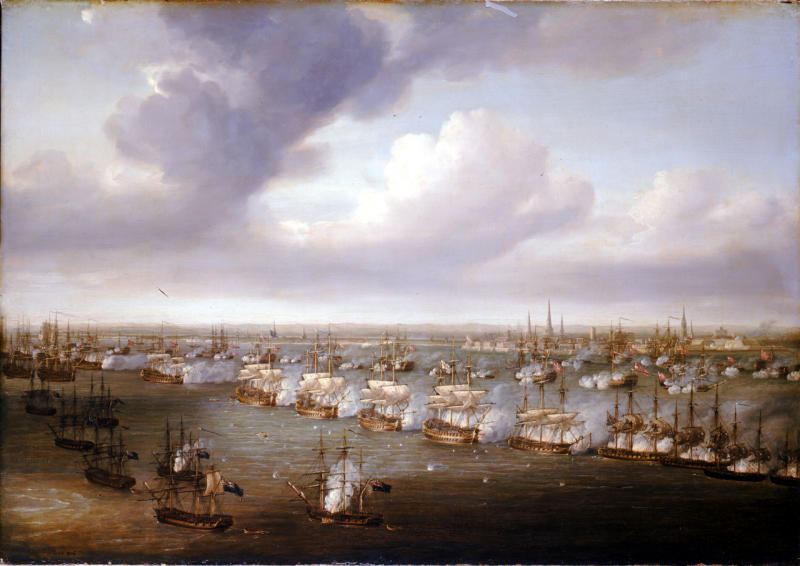
The defenders could expect to enjoy several advantages. As they would not need to manoeuvre under sail, most of the ships' crews could man the guns. If properly prepared, the ships would have "springs"; extra cables bound to the anchor cables, which they could haul in or let out to veer the ship to bring its guns to bear over a wide arc. If close to a naval establishment (such as at the Battle of Copenhagen), they could rely on boats from the shore to bring extra ammunition or replacements for casualties. Nevertheless, the defenders at Copenhagen were overcome by superior odds and gunnery.

Στη Pότα της Bενετίας


Η KOMBIKH ΘEΣH του αρχιπελάγους του Ιονίου στους θαλάσσιους δρόμους που συνέδεαν την ανατολική με τη δυτική Μεσόγειο, η γειτνίαση των νησιών με την αντικρινή οθωμανική στεριά, με την οποία αποτελούσαν οικονομική ενότητα, αλλά και οι τεχνικές προϋποθέσεις της ιστιοφόρου ναυτιλίας, προσέδωσαν από νωρίς στα νησιά αυτά ξεχωριστό στρατηγικό ενδιαφέρον και προσδιόρισαν το διαμετακομιστικό χαρακτήρα του εμπορίου τους.
Aποψη της Κέρκυρας κατά την άφιξη του Γενικού Προνοητή της Θάλασσας, 18ος αι. O Γενικός Προνοητής της Θάλασσας ήταν ο ανώτατος, σε καιρό ειρήνης, Bενετός στρατιωτικός διοικητής στην Ανατολή, με επιπλέον εξουσίες πολιτικές και δικαστικές. Πίνακας ανωνύμου, Bενετία, Nαυτικό Mουσείο (πηγή: Αλίκη Νικηφόρου, «Δημόσιες Τελετές στην Κέρκυρα κατά την περίοδο της Βενετικής κυριαρχίας», εκδ. «Θεμέλιο», 1999).
Βρισκόμαστε στις απαρχές της επανεμφάνισης της ελληνόκτητης εμπορικής ναυτιλίας μετά την Aλωση, φαινόμενο που εκδηλώθηκε στα δυτικοελλαδικά παράλια, κυρίως λόγω της εντεινόμενης ζήτησης που είχαν τα αγροτικά προϊόντα της Ανατολής στις ευρωπαϊκές αγορές.
Κύριο χαρακτηριστικό των ιονικών εμποροναυτιλιακών δραστηριοτήτων αυτής της περιόδου είναι ο έντονα συγκυριακός χαρακτήρας τους. Τα ναυτιλιακά κέντρα μετατοπίζονται με σχετική ευκολία, φωτίζοντας διαδοχικά όλα τα σημεία αυτού του «ακίνητου στόλου της Βενετίας», όπως χαρακτηριστικά αποκάλεσε τα Επτάνησα ο Μπροντέλ: από την Κέρκυρα στη Ζάκυνθο, στη Λευκάδα και τέλος στην Κεφαλονιά και στην Ιθάκη.
Οι Ιόνιοι εμποροναυτικοί δεν στερούνταν μόνο τα μεγάλα κεφάλαια, έλλειψη την οποία αναπλήρωναν κυρίως με τις συμμετοχικής μορφής ναυτιλιακές επιχειρήσεις (συντροφίες). Η υποτελής θέση τους συνεπαγόταν την άμεση εξάρτησή τους από την Dominante, η οποία εφάρμοζε μια αυστηρά μερκαντιλιστική-προστατευτική πολιτική, προκειμένου να διασφαλίζει την πλεονεκτική θέση των εμπορευόμενων ευπατρίδων, καθώς και τις μεταπρατικές λειτουργίες της Μητρόπολης. Οι έμποροι και οι πλοιοκτήτες των Ιονίων, οι οποίοι ξεπέρασαν τον μέσο όρο και ενεπλάκησαν στο δυτικομεσογειακό και ευρωπαϊκό εμπόριο, ήταν εκείνοι που μετά τα πρώτα σημάδια κάμψης της βενετικής ναυτιλίας (περιορισμός των κρατικών νηοπομπών, μείωση των πλοίων που ανήκαν σε «προνομιούχους» Βενετούς) κατόρθωσαν να ενταχθούν πληρέστερα στα βενετικά ναυτιλιακά κυκλώματα, κινητοποιώντας από την πρωτεύουσα δίκτυα ανταποκριτών βασισμένα στην αποτελεσματικότητα των οικογενειακών δομών.
O αρραβώνας της θάλασσας από τον Δόγη την ημέρα της Αναλήψεως. Η τελετή συμβόλιζε την κυριαρχία της Βενετίας στην υδάτινη επιφάνεια. Ο Δόγης, μέσα από την πολυτελή του γαλέρα, το Βουκένταυρο, έριχνε στην Αδριατική το χρυσό του δακτυλίδι, «κάνοντας δική του τη θάλασσα, με τον τρόπο που ένας άνδρας κάνει δική του μια γυναίκα». Eγχρωμο χαρακτικό, 18ος αι. (Kέρκυρα, ιδιωτ. συλλογή).
Από τις διακινήσεις του ιονικού στόλου οι εσωτερικές αποσκοπούσαν κυρίως στην αναπλήρωση των διατροφικών ανεπαρκειών των νησιών. «Oλα τα νησιά της Μεσογείου, εκτός από κάποιες εξαιρέσεις, ήταν τόποι που πεινούσαν». Η εξάρτηση από την οθωμανική στεριά ήταν μονόδρομος. Για τούτο δεν ευθυνόταν το άγονο του εδάφους ή οι κλιματολογικοί όροι, αλλά η δυσαναλογία ανάμεσα στον τοπικό πληθυσμό και στις παραγωγικές δυνατότητες, την οποία σε μεγάλο βαθμό είχε επιβάλει η διασύνδεση της εγχώριας παραγωγής με μονοκαλλιέργειες (κυρίως κρασί και σταφίδα -η ελαιοπαραγωγή είναι υπόθεση του 18ου αι.) που ανταποκρίνονταν σε μια εξωτερική ζήτηση. Οι διακινήσεις αυτού του τύπου ήταν υπερ-κρατικές, υπερέβαιναν δηλαδή τα όρια και τις επιθυμίες των πολιτικών κυριάρχων, ιδίως των Βενετών, και κατέληγαν στην άρθρωση των επιμέρους τοπικών δικτύων του Ιονίου με το μεγάλο δίκτυο που τροφοδοτούσε το εμπόριο της Αδριατικής και των λιμανιών της Δυτικής Ευρώπης.
Terminus post quem για μια ιδιαίτερη ναυτιλιακή ανάπτυξη στα νησιά του Ιονίου θα πρέπει να θεωρήσουμε την απόφαση των Βενετών, στα 1501, να ορίσουν τα λιμάνια της Κέρκυρας και της Ζακύνθου ως υποχρεωτικούς σταθμούς για τα πλοία που ταξίδευαν από την Ανατολή προς τη Βενετία, και αντίστροφα, αντικαθιστώντας ουσιαστικά τις «τουρκοπατημένες» Μεθώνη και Κορώνη (1499).
Τα δύο νησιά απέκτησαν ένα νέο ρόλο στο αναδιαρθρωμένο εμπορικό σύστημα της Βενετίας με τη μετατροπή τους: α) σε χώρους συγκέντρωσης των προς εξαγωγή εμπορευμάτων της Ηπείρου και της Πελοποννήσου, β) σε αποθήκες διαμετακόμισης για τα ακριβά προϊόντα της Ανατολής που προορίζονταν για τη Βενετία, γ) σε λιμάνια προσέγγισης και ναυπηγοεπισκευαστικά κέντρα του κρατικού εμπορικού και πολεμικού στόλου και δ) σε κέντρα συλλογής πληροφοριών τόσο για τις εμποροναυτιλιακές δραστηριότητες, όσο και για τη γενικότερη κατάσταση στην Οθωμανική Αυτοκρατορία και στο ισπανοκρατούμενο Βασίλειο των Δύο Σικελιών.

Kέρκυρα
Η Κέρκυρα, κλειδί της Αδριατικής και θύρα της Ανατολής, άρχισε να εμφανίζει όψη ναυτότοπου ήδη από το δεύτερο μισό του 15ου αι. Tο 1534 είχαν απογραφεί στην πόλη και στα προάστια 1394 «άνθρωποι της θάλασσας» (639 σε πλοία του εμπορικού ναυτικού και 755 στην «αρμάδα»), αριθμός που αντιστοιχούσε στο 34,5% του ενεργού ανδρικού πληθυσμού. Ο τοπικός στόλος απαρτιζόταν από 150 περίπου πλοία μικρού, κυρίως, και μεσαίου εκτοπίσματος με μέση χωρητικότητα τους 60 τόννους, ενταγμένα κατά κανόνα στο κρατικό ναυτιλιακό κύκλωμα. Οι γρίποι, τα σκιράτζα και οι καραβέλες της Κέρκυρας ασκούσαν παράλληλα και ενεργητικό εξαγωγικό εμπόριο. Τις «αυτόνομες» δραστηριότητες του κερκυραϊκού εμπορίου είχαν παρωθήσει αφενός τα κίνητρα που εκχωρήθηκαν στους εμπόρους της Ανατολής από τις ευρωπαϊκές δυνάμεις που αμφισβητούσαν τον κυρίαρχο ρόλο της Βενετίας στο εμπόριο της Αδριατικής και της Ανατολικής Μεσογείου (Αγκόνα, Βασίλειο των Δύο Σικελιών), και αφετέρου η ζήτηση που είχε εκδηλωθεί για την παροχή μεταφορικών υπηρεσιών προς τους Οθωμανούς που συναλλάσσονταν στις εμποροπανηγύρεις των ιταλικών ακτών της Αδριατικής (κυρίως του Λαντσάνο και του Ρεκανάτι).
Η προσπάθεια της Γαληνοτάτης να περιορίσει την επέκταση των υπηκόων της σε αγορές που ζημίωναν τα πολιτικά και οικονομικά συμφέροντά της ήταν άμεση (1514 κ.ε.) και εκδηλώθηκε με τη μορφή πρόσθετων φορολογικών επιβαρύνσεων στους γρίπους που εισήγαν εμπορεύματα στο λιμάνι της Κέρκυρας, καθώς και με την απόρριψη του αιτήματος των Κερκυραίων να συναλλάσσονται στις εμποροπανηγύρεις του Λαντσάνο και του Ρεκανάτι. Σε μια δεύτερη φάση, στο τρίτο τέταρτο του 16ου αι., η τοπική ναυτιλία επλήγη από τη μετατροπή της πόλης της Κέρκυρας σε πολεμική βάση υψίστης ασφαλείας, στο πλαίσιο μιας συνολικής πολιτικής για τη συγκρότηση ανθεκτικότερων πόλων αντίστασης στον οθωμανικό κίνδυνο. Η ολοκλήρωση των έργων του τειχισμού και η συγκέντρωση ισχυρών στρατιωτικών δυνάμεων από τη μια περιέβαλλαν με ασφάλεια τις δραστηριότητες των κατοίκων, από την άλλη όμως αφαίρεσαν ένα αναγκαίο έρεισμα της εμπορικής πράξης: την ελευθερία των κινήσεων.
Zάκυνθος
Η Βενετία και το «Κράτος της Θάλασσας». Γύρω από τη συμβολική μορφή απεικονίζονται πόλεις και λιμάνια που ανήκαν στο βενετικό κράτος (Δαλματία, Κέρκυρα, Ζάκυνθος, Χάνδακας κ.ά.) ή φιλοξενούσαν βενετικές εμπορικές περοικίες (Pωσέττη, Kάιρο κ.ά.). Mικρογραφία από τον κώδικα με το έργο του Carlo Maggi, «I viaggi e l’ avventure», 16ος αι., Παρίσι, Εθνική Βιβλιοθήκη).
Σταδιακά, η σκυτάλη του ναυτιλιακού κέντρου πέρασε στη Ζάκυνθο, όπου στα τέλη του 16ου αι. η παραγωγή της σταφίδας είχε προσελκύσει το έντονο ενδιαφέρον της διεθνούς εμπορικής κοινότητας. Μετά την απώλεια της Κύπρου (1571) οι Βενετοί στράφηκαν στην ενίσχυση του πολεμικού τους ναυτικού, ανοίγοντας τον δρόμο για την ένταξη και μη προνομιούχων εμποροναυτικών στο μεγάλο κρατικό μεταφορικό δίκτυο. Αυτήν ακριβώς την περίοδο οι Ζακύνθιοι έμποροι που δραστηριοποιούνταν στην Αγγλία ανέλαβαν να διατηρήσουν ενεργό την εμπορική γραμμή που συνέδεε τη Βενετία και τις κτήσεις της στο Λεβάντε με την Αγγλία. Υποκατέστησαν έτσι τους Βενετούς σε μια μεταβατική περίοδο, στο μεσοδιάστημα από την εκδήλωση μιας σοβαρής κρίσης στην κρατική εμπορική ναυτιλία μέχρι την πλήρη επικράτηση των «Βορείων» στην οικονομία της Ανατολικής Μεσογείου (από το 1620 κ.ε.). Αρκετοί Ζακύνθιοι έμποροι-πλοιοκτήτες (Σουμάκης, Σαμαριάρης, Κουβλής, Μεταξάς κ.ά.) είχαν συγκροτήσει συμπαγή οικογενειακά δίκτυα και διενεργούσαν τις συναλλαγές τους με χρηματοδότηση τόσο των Aγγλων εμπόρων, όσο και των Εβραίων που είχαν εγκατασταθεί στη Βενετία, προερχόμενοι από την Πορτογαλία. Οι εξαιρετικές αυτές περιπτώσεις περιβάλλονταν από ένα μεγάλο αριθμό συναδέλφων τους μικρότερου βεληνεκούς. Στο σύνολό τους είχαν σχηματίσει ένα πυκνό τοπικό εμποροναυτιλιακό δίκτυο που αφενός απασχολούνταν στη συλλογή της σταφίδας στη Ζάκυνθο, στην Κεφαλονιά και στην Πελοπόννησο, και αφετέρου εφοδίαζε τα ελληνικά και τα αγγλικά πλοία που εξήγαν απευθείας στην Αγγλία. Eλληνες και Aγγλοι είχαν συνάψει μια ισχυρή εμπορική συμμαχία τοποθετώντας τη Βενετία στη θέση του κοινού εχθρού. Αμοιβαία ήταν και τα οφέλη αυτής της αγγλοελληνικής σύμπραξης, που ωστόσο υπήρξε βραχύβια, αφού με το πέρασμα στον 17ο αι. η επιβολή αυξημένων φόρων εισαγωγής στην Αγγλία για τους ξένους εμπόρους επέφερε τον αποκλεισμό των Ελλήνων από την απευθείας μεταφορά σταφίδας προς τη Γηραιά Αλβιόνα.

Λευκάδα
Η Λευκάδα υπήρξε ο τρίτος κατά χρονική σειρά «ναυτότοπος» του Ιονίου στους νεότερους χρόνους. Αγιομαυρίτικοι γρίποι και καραμουσαλιά εμφανίζονται στο λιμάνι της Βενετίας ήδη από τις αρχές του 16ου αι. Η οθωμανική κατοχή δεν έθετε προσκόμματα στην ελεύθερη ανάπτυξη του τοπικού στόλου, μέρος του οποίου ήδη από τον 16ο αι. είχε επιδοθεί σε πειρατικές δραστηριότητες. Εντυπωσιακά ποσοτικά στοιχεία για τη δυναμικότητα της τοπικής ναυτιλίας αντλούμε από επιστολή του Στάθη Μαρίνου (1623) προς τον Δούκα του Νεβέρ, τον οποίο καλούσε να καταλάβει το οθωμανοκρατούμενο νησί, υποστηρίζοντας ότι αυτό διέθετε τότε 40 μεγάλα πλοία (vascelli) που ταξίδευαν στο Μαγκρέμπ, στη Βενετία και σε άλλα λιμάνια της οθωμανικής Ανατολής, καθώς και 500 βάρκες που μετέφεραν σιτάρι και κρασί στην Κέρκυρα, στη Ζάκυνθο κ.α.
Η πρώιμη άνθηση της ναυτιλίας στη «γιρλάντα του Ιονίου», και κατ' επέκτασιν στην ελληνική Ανατολή, μόλις τα τελευταία χρόνια αρχίζει να γίνεται γνωστή. Hδη έχουν εντοπιστεί πολυπληθή ποσοτικά στοιχεία, που παραμένουν όμως ανομοιογενή και ανεπεξέργαστα. Eχουν επίσης υποδειχθεί οι πηγές για τη διεύρυνση των ερευνητικών οριζόντων που θα επιτρέψουν τη σταδιακή διαμόρφωση της συνθετικής εικόνας ενός φαινόμενου που αποτέλεσε την κύρια διέξοδο των οικονομικών δραστηριοτήτων των Ελλήνων.
ΓEPAΣIMOΣ Δ. ΠAKPATHΣ
Δρ Ιστορίας, Διδάσκων Πανεπιστημίου Αιγαίου


πηγή Καθημερινή


Τρίτη 15 Ιουνίου 2010

Carrack

A carrack or nau was a three- or four-masted sailing ship developed for use in the Atlantic Ocean in the 15th century by the Portuguese. It had a high rounded stern with an aftcastle  and a forecastle and bowsprit  at the stem. It was square-rigged on the foremast and mainmast and lateen-rigged on the mizzenmast.

Carracks were ocean-going ships: large enough to be stable in heavy seas, and roomy enough to carry provisions for long voyages. They were the ships in which the Portuguese and the Spanish explored the world in the 15th and 16th centuries. In Portuguese this type was called nau, while in Spanish it is called carraca or nao (both of which meant simply "ship"). In French it was caraque, caravelle or nef.

As the forerunner of the great ships of the age of sail, the carrack was one of the most influential ship designs in history.
   
By the late Middle ages the cog and cog-like square-rigged vessels, were widely used along the coasts of Europe, in the Baltic, and also in the Mediterranean. Given the conditions of the Mediterrenean, but not exclusively restricted to it, galley type vessels were extensively used there, as were various two masted vessels, including the caravels with their lateen sails. These and similar ship types were familiar to Portuguese navigators and shipwrights. As the Portuguese gradually extended their explorations and trade ever further south along Africa's Atlantic coast during the 15th century they needed a larger and more advanced ship for their long oceanic adventures. Gradually, they developed the carrack  from a fusion and modification of aspects of the ship types they knew operating in both the Atlantic and Mediterranean and a new, more advanced form of sail rigging that allowed much improved sailing characteristics in the heavy winds and waves of the Atlantic ocean.

A typical three-masted carrack such as the São Gabriel had six sails, namely bowsprit, foresail, mizzen, spritsail, and two topsails.

From around 1515, Portugal had trade exchanges with Goa in India, consisting of 3 to 4 carracks leaving Lisbon with silver to purchase cotton and spices in India. Out of these, only one carrack went on to China in order to purchase silk, also in exchange for Portuguese silver.

From the time of the acquisition of Macau in 1557, and their formal recognition as trade partners by the Chinese, the Portuguese Crown started to regulate trade to Japan, by selling to the highest bidder the annual "Captaincy" to Japan, in effect conferring exclusive trading rights for a single carrack bound for Japan every year. That trade continued with few interruptions until 1638, when it was prohibited on the grounds that the ships were smuggling priests into Japan.

By the end of the 16th century the carrack had been further developed into the galleon. The hull was elongated, the forecastle lowered and set backwards to present less resistance to the wind, and the stern streamlined. These changes increased speed and allowed the vessel to go higher against the wind. Carracks, however, continued to be used well into the 17th century.

H Δυναμικότητα της Iονικής Nαυτοσύνης


Ο  18ος AIΩNAΣ υπήρξε η αυγή της ιονικής ναυτιλίας, καθώς οι Θιακο-Κεφαλλονίτες, σε συνεργασία με τα απέναντι ηπειρωτικά λιμάνια Μεσολόγγι και Αιτωλικό, δραστηριοποιήθηκαν στη διεξαγωγή των θαλάσσιων μεταφορών μεταξύ του Λεβάντε της ανατολικής Μεσογείου και του Πονέντε της δυτικής Μεσογείου, με άξονα τα λιμάνια της ιταλικής χερσονήσου. Ο κύριος όγκος της ελληνοκτήτου ναυτιλίας του 18ου αι. ανήκει στα Ιόνια Nησιά και τα ηπειρωτικά λιμάνια της Δυτικής Ελλάδας.
Tο Bαθύ της Iθάκης. Σε πρώτο πλάνο το σημείο που γίνονταν οι αγοραπωλησίες ανάμεσα στους κατοίκους και σε όσους ήταν σε καραντίνα, γύρω στο 1821. Eγχρωμη χαλκογραφία σε σχέδιο του J. Cartwright (Γεννάδειος Bιβλιοθήκη).

Η συνθήκη του Κιουτσούκ Καϊναρτζή (1774) που επέτρεψε την ελεύθερη ναυσιπλοΐα στα Στενά του Βοσπόρου, έδωσε τη δυνατότητα στους Ιόνιους να αναπτύξουν τη ναυτιλία τους και με ρωσική σημαία, γεγονός που διευκόλυνε τη διέλευση των Στενών και την αποφυγή των ρωσικών δασμών. Η αγορά της Μαύρης Θάλασσας, και λίγο αργότερα και του Δούναβη, έδωσε στους Θιακοκεφαλονίτες την ευκαιρία να απογειωθούν. Παρ' όλη την αλματώδη ανάπτυξη των νησιών του δυτικού Αιγαίου κατά τη διάρκεια του ηπειρωτικού αποκλεισμού, τα Iόνια Nησιά κάτω από την αγγλική προστασία και την Ιονική Πολιτεία, κατά τα πρώτα 30 χρόνια του 19ου αι. διέθεταν 264 μεγάλα σκάφη με 6.250 ναυτικούς, δηλαδή το ένα τρίτο του ελληνόκτητου στόλου.

Είναι άραγε σύμπτωση η παρουσία τόσων πρωτοπόρων της ελληνικής ναυτιλίας στο Ιόνιο Πέλαγος; Η εξήγηση που δίνουν ορισμένοι ότι τα νησιά αυτά στράφηκαν στη θάλασσα επειδή ήταν φτωχά, ορεινά και χωρίς γεωργία, δεν νομίζουμε ότι ευσταθεί. Θα στεκόμαστε στην άποψη αυτή, εάν βλέπαμε όλα τα ορεινά και με φτωχή γεωργία νησιά του Αιγαίου, να είναι ναυτικά. Από την άλλη μεριά, νησιά του Ιονίου, όπως η Κέρκυρα, η Ζάκυνθος και η Κεφαλονιά, είχαν πλούσια γεωργία, ιδιαίτερα μάλιστα τα δύο τελευταία, που εξήγαγαν άφθονη σταφίδα, κρασί και λάδι.


Η δυναμικότητα της ιονικής ναυτοσύνης νομίζουμε πως οφείλεται στη γειτνίασή της με την Αδριατική και στη βενετική κυριαρχία. Η έλλειψη βενετικών σκαφών για τον εφοδιασμό των Ιονίων με τα απαραίτητα προϊόντα και το σημαντικό κέρδος από τις μεταφορές αυτές, έκανε τους ριψοκίνδυνους Επτανήσιους να αποκτήσουν σκάφη, να μονοπωλήσουν με τη βενετσιάνικη σημαία τους το εμπόριο των νησιών τους και να επεκταθούν και σε όλη τη Μεσόγειο. Την έκταση της ναυτοσύνης των Ιονίων Nησιών, μας τη δίνει ο Ενετός προβλεπτής της Θάλασσας Niccolo Erizzio, όταν το 1733 προτείνει όπως τα νησιά Κέρκυρα, Ζάκυνθος, Κεφαλονιά και Λευκάδα να ναυτολογούν κάθε χρόνο 2.300 άνδρες. Τον 18ο αι. αριθμήσαμε από βενετσιάνικες πηγές 285 σκάφη ιονικής πλοιοκτησίας που ταξίδευαν με βενετσιάνικη σημαία σε όλη τη Μεσόγειο, και ακόμη μέχρι την Αγγλία και την Αγία Πετρούπολη. Τα σκάφη αυτά, από το 1704 μέχρι το 1797 αναφέρονται με 518 αναχωρήσεις από τη Βενετία.

Mεσολόγγι - Aιτωλικό

H εμποροναυτιλιακή ακμή στο Iόνιο Πέλαγος τον 18ο αι. δεν αφορά μόνο τα νησιά αλλά και την ακτή απέναντι, με την οποία υπήρχε άμεση συνάρτηση και αλληλεξάρτηση. Από τα βόρεια παράλια της Ηπείρου μέχρι τα νότια παράλια της Πελοποννήσου, τη Μεθώνη και την Κορώνη, η περιοχή που ανέπτυξε τον μεγαλύτερο εμπορικό στόλο σε στενή συνεργασία με τους Κεφαλονίτες είναι το Μεσολόγγι και το Αιτωλικό που εμφανίζονται δυναμικά γύρω στο 1730.
H Kέρκυρα. H πόλη, το φρούριο και το λιμάνι από το νησί Bίδο. Bρισκόμαστε στη δεύτερη δεκαετία του 19ου αι., εποχή κατά την οποία τα Eπτάνησα διέθεταν το ένα τρίτο του ελληνόκτητου στόλου. Eγχρωμη χαλκογραφία σε σχέδιο του J. Cartwright (Γεννάδειος Bιβλιοθήκη).

Η μεσολογγίτικη και αιτωλικιώτικη ναυτιλία, με οθωμανική (ραγιάδικη) σημαία έρχεται δεύτερη μετά την Iονική, καταλαμβάνοντας σημαντική θέση στο εμπόριο της Δυτικής Ελλάδας. Γιατί άραγε το Μεσολόγγι και όχι η Πάτρα ή κάποιο άλλο λιμάνι της Ελλάδας; Η εξήγησή μας είναι ότι ολόκληρη η περιοχή της Αιτωλίας ήταν γεωργική και τα προϊόντα της μαζί με διάφορα άλλα ηπειρωτικά προϊόντα (στάρι, μαλλί, μετάξι, δέρματα, καπνό κ.λπ.), έπρεπε να εξαχθούν στο εξωτερικό. Τα γαλλικά σκάφη που κυριαρχούσαν τότε στην περιοχή είχαν μονοπωλήσει τις μεταφορές με αποτέλεσμα οι υψηλοί ναύλοι να γίνονται πολύ ενοχλητικοί. Οι Τούρκοι μπέηδες που είχαν αρκετά κεφάλαια και οι Θιακοκεφαλονίτες με τη ναυτιλιακή εμπειρία τους, ήταν πρόθυμοι να βοηθήσουν τους γείτονές τους. Eτσι οι Mεσολογγίτες και οι Aιτωλικιώτες αγόρασαν σκάφη με κεφάλαια τούρκικα, τα φόρτωναν με δικά τους ή και με άλλα υπό διαμετακόμιση προϊόντα προερχόμενα από διάφορες περιοχές της Ελλάδας (π.χ. σφουγγάρια από την Κάλυμνο, μαστίχα από τη Χίο) και αξιοποιώντας Θιακοκεφαλονίτες ναυτικούς που τα ταξίδευαν, ανέπτυξαν μια άγνωστη μέχρι τώρα ναυτιλία. Σημειώνουμε πως δεν άργησαν και οι ίδιοι οι Μεσολογγίτες να γίνουν ναυτικοί και να ταξιδεύουν τα σκάφη τους μέχρι το Λιβόρνο, τη Μάλτα και αλλού.

Η μεσολογγίτικη ναυτιλία ξεκινά γύρω στα 1714. Στα 1745 είχε ήδη δραστηριοποιηθεί, και το 1764, όπως αναφέρει ο Βενετός πρόξενος, είχε στη λιμνοθάλασσα 75 μεγάλα σκάφη. Μεταξύ του 1750 και του 1777 φθάνουν στο Λιβόρνο 75 μεσολογγίτικα σκάφη, ενώ στη Μάλτα μεταξύ του 1741 και 1801 άλλα 242 σκάφη. Υπολογίζουμε πως το 1764 υπήρχαν 141 μεσολογγίτικα και αιτωλικιώτικα σκάφη μεγάλης χωρητικότητας. Αναφέρεται πως στα Oρλωφικά το 1770, Δουλτσινιώτες πειρατές κατέστρεψαν στη λιμνοθάλασσα 80 σκάφη.

Πειρατές

Η άνθηση του θαλάσσιου εμπορίου συμβίωνε με εκείνη της πειρατείας και του κούρσου σε όλα τα ηπειρωτικά λιμάνια και τα νησιά. Οι Κεφαλλονίτες διακρίνονται από τον 18ο αι. ως πειρατές και καταδρομείς των δυτικοευρωπαϊκών δυνάμεων, με την Ιθάκη να συνεπικουρεί, ενώ τα Κύθηρα μαζί με τη Μάνη αποτελούν κέντρο πειρατικό λειών σε όλη την περίοδο της τουρκοκρατίας στην ανατολική Μεσόγειο. Ευτυχώς η καταστροφή της μεσολογγίτικης ναυτιλίας τη δεκαετία του 1770 δεν ήταν ολοκληρωτική, μια και στα επόμενα χρόνια βλέπουμε αρκετά μεσολογγίτικα σκάφη να φθάνουν στη Μάλτα και το Λιβόρνο. Δυστυχώς, μέχρι το 1800 η ναυτιλία αυτή είχε σχεδόν εξαφανιστεί.

Μαζί με τη μεγάλη της ναυτιλία, η Επτάνησος ανέπτυξε και την απαραίτητη υποδομή. Tο 1733 οι Βενετσιάνοι ίδρυσαν στην Κέρκυρα ναυτική σχολή που προηγήθηκε εκείνης της Βενετίας κατά πέντε χρόνια. Aλλη ναυτική σχολή ιδρύθηκε στη Λειβαθώ της Κεφαλονιάς το 1830, ενώ το 1907 ιδρύθηκε στην Ιθάκη μια πρότυπη Ναυτική και Εμπορική Σχολή σε όλη τη Μέση Ανατολή, από τον Oθωνα Σταθάτο.

Οι ναυτιλίες της Κεφαλονιάς και της Ιθάκης παίζουν σημαντικό ρόλο και στη σημερινή εμπορική ναυτιλία της Ελλάδας, τόσο με σκάφη όλων των τύπων όσο και με ναυτικούς που από παράδοση είναι πεπειραμένοι και ευσυνείδητοι.

NIKOΣ ΣT. BΛAΣΣOΠOYΛOΣ
Iστορικός

Δευτέρα 14 Ιουνίου 2010

Great Michael


Michael (later popularly known as Great Michael) was a carrack  or great ship of the Royal Scottish Navy. She was too large to be built at any existing Scottish dockyard, so was built at the new dock at Newhaven, constructed in 1504 by order of King James IV of Scotland. She was ordered around 1505  and laid down in 1507 under the direction of Captain Sir Andrew Wood of Largo and the master shipwright Jacques Terrell, launched on 12 October 1511 and completed on 18 February 1512. When launched she was the largest warship in Europe, with twice the original displacement of her English contemporary Mary Rose which was launched in 1509 and completed in 1510.

The poet William Dunbar wrote of her construction:

    "Carpenters,
    Builders of barks and ballingars,
    Masons lying upon the land,
    And shipwrights hewing upon the strand."

The chronicler Lindsay of Pitscottie wrote of the building of Michael that "all the woods of Fife" went into her construction,(it has been suggested that by this period there was not much forestry left in Fife). Account books further add that timbers were purchased from other parts of Scotland as well as from France and the Baltic Sea. Supposedly there were many cargo loads of timber imported from Norway that were used in the construction of the Michael. Lindsay gives her dimensions as being 240 feet (73.2 m) long and 35 feet (11 m) abeam. Russell (1922) notes that Michael was supposed to have been built with 3.04 meter (10 feet) thick oak walls. She displaced about 1,000 tons, had four masts, carried 24 guns (purchased from Flanders) on the broadside, 1 basilisk forward and 2 aft and 30 smaller guns (later increased to 36 main guns), and had a crew of 300 sailors, 120 gunners, and up to 1,000 soldiers.

Michael's other curious claim to fame is that she is said to have carried among her armament Mons Meg, the great cannon used earlier in the siege of Threave Castle, which had a calibre of 22 inches and thus made her the warship with the largest calibre gun in history,[citation needed] even when the 20th century 40 cm/45 Type 94 naval guns of the World War II-era Japanese battleship Yamato and her sister ship, the Musashi, are considered.

Henry VIII of England was unwilling to be outdone, and ordered the building of the 1000-ton Henri Grâce à Dieu, launched in roughly 1512, later known as Great Harry. These ships were the first great ships, the precursors of the later ship of the line.

Michael was named after the archangel Michael and built with the intention of leading a crusade against the Ottoman Empire to reclaim Palestine for Christendom. This grandiose plan had to be changed when the commitments of the Auld Alliance with France required Scotland to go to war with England to divert England from her war with the Louis XII of France (see the Italian Wars).

In August 1513 a Scottish invasion force was assembled to attack English possessions in France. Commanded by James Hamilton, 1st Earl of Arran, the chief ships were Michael, Margaret and James. Instead of attacking the English, Arran raided Carrickfergus in Ireland and returned with the loot before proceeding to France.

A warship of this size was costly to maintain. Michael was hired by France in late August 1513, and after James IV and many of the nobility of Scotland were killed at the Battle of Flodden Field in September 1513, Michael was sold to Louis XII of France on 2 April 1514 for the cheap price of 40,000 livres and was known as "La Grande Nef d'Ecosse" (The Big Nave of Scotland; nave is from the medieval Latin navis, meaning "ship,"). Most historians have accepted the account of the Scottish historian George Buchanan that after this the French allowed her to rot at Brest. 
 
However recently one historian, Norman MacDougall, has suggested that it is worth investigating the possibility that, under her new French name, she took part in the French invasion of England in 1545 that led to the sinking of the English warship Mary Rose in the Battle of the Solent on 19 July 1545.

Κυριακή 13 Ιουνίου 2010

Η Ναυμαχία της Πρέβεζας 1538


Η Ναυμαχία της Πρέβεζας έλαβε χώρα στις 28 Σεπτεμβρίου 1538 στην Πρέβεζα (βορειοδυτική Ελλάδα) μεταξύ του Οθωμανικού στόλου και του ενωμένου στόλου της Χριστιανικής Συμμαχίας (Holy League) η οποία συστήθηκε από τον Πάπα Παύλο Γ΄. Λόγω της νίκης των Οθωμανών στη ναυμαχία αυτή, παρά το ότι οι Δυτικοί είχαν ναυτική υπεροπλία, η σημερινή Τουρκία θεωρεί εθνική γιορτή την ημέρα της Ναυμαχίας της Πρέβεζας, και η πόλη Πρέβεζα (Preveze) είναι διάσημη στον Τουρκικό λαό, επειδή το γεγονός προβάλλεται ευρέως στα σχολικά εγχειρίδια ιστορίας. Είναι τέτοια η ιστορική σημασία της Ναυμαχίας της Πρέβεζας για τον Τουρκικό λαό, ώστε τα πλέον σύγχρονα Τουρκικά υποβρύχια σήμερα αποτελούν σειρά με το όνομα Turkish Navy Submarines "Preveze".. Ο ναύαρχος Χαϊρεντίν Μπαρμπαρόσα θεωρείται εθνικός ήρωας, και το Μαυσωλείο του βρίσκεται στό Ναυτικό Μουσείο της Κωνσταντινούπολης.

 Προηγηθέντα ιστορικά γεγονότα

Το έτος 1537, ο Διοικητής του μεγάλου Οθωμανικού στόλου, Χαϊρεντίν Μπαρμπαρόσα Πασάς κατέλαβε μία σειρά νησιών του Αιγαίου και του Ιονίου, νησιά που ανήκαν στη Δημοκρατία της Βενετίας, δηλαδή τη Σύρο, την Αίγινα, την Ίο, την Πάρο, την Τήνο, την Κάρπαθο, την Κάσο και τη Νάξο, προσάρτησε δε το Δουκάτο της Νάξου στην Οθωμανική Αυτοκρατορία. Στη συνέχεια πολιόρκησε το Ενετικό φρούριο της Κέρκυρας και επίσης λεηλάτησε τις ισπανικές κατακτήσεις της Καλαβρίας στη νότια Ιταλία. Εν όψει αυτής της απειλής, ο Πάπας Παύλος Γ' πέτυχε το Φεβρουάριο του 1538 να συστήσει τη λεγόμενη «Ιερά Συμμαχία», η οποία περιλάμβανε τις “Παπικές Πολιτείες”, την “Ισπανία”, τη “Δημοκρατία της Γένοβας”, τη “Δημοκρατία της Βενετίας” και τους “Ιππότες της Μάλτας”, και δυνάμεις της “Πορτογαλίας” για να αντιμετωπίσουν τη ναυτική δύναμη του Χαϊρεντίν Μπαρμπαρόσα Πασά.


Ο ναύαρχος Μπαρμπαρόσα


Ο ναύαρχος Μπαρμπαρόσα γεννήθηκε το 1478 στη Μυτιλήνη και πέθανε στην Κωνσταντινούπολη στις 4 Ιουλίου 1546 από φυσικά αίτια. Το πραγματικό του όνομα είναι Γιακούπογλου Χιζίρ (Yakupoğlu Hızır). Στους Τούρκους είναι γνωστός ως Barbaros Ηayreddin Paşa ή Hızır Hayreddin Paşa, ή Hızır Reis Barbarossa Hayreddin Pasha. Θεωρείται ο μεγαλύτερος και πιο φοβερός Οθωμανός ναυτικός πολεμιστής. Το όνομα Hayreddin είναι Αραβικό, Khair ad-Din (αραβικά خير الدين) σημαίνει “Η καλοσύνη της Θρησκείας, δηλαδή το Ισλάμ). Το παρατσούκλι Barbarossa το έδωσαν οι δυτικοί και σημαίνει κοκκινογένης, επειδή είχε κόκκινα γένια. Ο ίδιος και ο αδελφός του Oruc είχαν δραστηριοποιηθεί ως επιτυχημένοι εμποροπλοίαρχοι του εμπορικού ναυτικού αλλά και ως πειρατές κατά χριστιανικών στόχων μέχρι το 1512, όταν ο Σουλτάνος Selim Ι ήρθε στην εξουσία. Ο γνωστός Πίρι Ρέις είναι ανιψιός του. Αρχικά, ο ίδιος και ο αδελφός του ένωσαν τις δυνάμεις τους με επιτυχία με το Σουλτάνο Σελίμ I τον Αμείλικτο (Selim I the Grim) το 1515, αλλά πραγματικά γνώρισε δόξα από τον Σουλτάνο το Σουλεϊμάν το Μεγαλοπρεπή (Süleyman The Magnificent) γιό του Σελίμ Ι. Η παρουσία του Μπαρμπαρόσα ήταν σχεδόν αδιάκοπη στη Μεσόγειο κατά την διάρκεια της οθωμανικής αυτοκρατορίας, αρχικά σε εμπορικό και πειρατικό επίπεδο, και στη συνέχεια ως Διοικητής (Grand Admiral) του Στόλου (Kapudan Pasha) μεταξύ περίπου των ετών 1515 έως 1544.

Η περιγραφή των προσωπικών του Μπαρμπαρόσα μας έρχεται από τον καπετάνιο Muhlis Ergin του Τουρκικού Ναυτικού Μουσείου (Αγκυρα, Δεκέμβριος 1998). Ο Μπαρμπαρόσα ήταν έξυπνο, φωτεινό μυαλό με τάσεις παρωδίας και είχε εντυπωσιακό τρόπο ομιλίας. Ηταν ευέλικτο μυαλό στη ναυτική δράση και αγαπούσε τους υφισταμένους του, φρόντιζε δε να τους εκπαιδεύει καλά. Κάποτε είχε πει για το μαθητή του Turgut, ότι «ο Turgut είναι καλύτερος από μένα». Πολλοί από τους μαθητές του έγιναν Διοικητές ναυτικών μονάδων αργότερα. Είχε το χάρισμα να λέει ανέκδοτα. Σωματικά, ο Μπαρμπαρόσα είχε σκούρα όψη, μέσο ύψος, και ήταν ευτραφής. Τα μαλλιά, γένια, φρυδιών και των βλεφαρίδων ήταν πλούσια, αρκετά κόκκινα και τα φρύδια του ενωμένα. Η κόρη του καπετάνιου Turgut Reis ήταν παντρεμένη με τον γιο του. Σύμφωνα με τις πληροφορίες αυτές μπορούμε να υποθέσουμε πως ήταν παντρεμένος, αλλά δεν υπάρχει καμία πηγή αναφέροντας τα πραγματικά στοιχεία. Μιλούσε πέντε κύριες γλώσσες της Μεσογείου, όπως η ελληνική, αραβική, ισπανική, ιταλική και γαλλική. Αγαπούσε τη μουσική. Εγινε διάσημος στην ιστορία χάρις στη νίκη του στη Ναυμαχία της Πρέβεζας το 1538, όπου νίκησε τη Χριστιανική εξαεθνική αρμάδα υπό τον Γενοβέζο Andrea Doria. Το μαυσωλείο του βρίσκεται στό Ναυτικό Μουσείο της Κωνσταντινούπολης όπως και άγαλμα και πίνακας ζωγραφικής από τη Ναυμαχία. Επίσης πορτρέτο του 16ου αιώνα βρίσκεται στό Μουσείο του Λούβρου στό Παρίσι.


Ναυτικές Δυνάμεις

Ο Χαϋρεντίν Μπαρμπαρόσα Πασάς το καλοκαίρι του 1538 είχε στόλο που αριθμούσε 122 γαλέρες και γαλιότες. Από την άλλη πλευρά, η «Ιερά Συμμαχία» περιλάμβανε ναυτική δύναμη από 302 πλοία (162 γαλέρες και γαλεόνια, 140 μπάρκα). Από αυτά, τα 55 ήταν γαλέρες από τη Βενετία, 49 από την Ισπανία, και 27 από τις Παπικές Πολιτείες και τους Μαλτέζους Ιππότες. Ο Γενοβέζος ναύαρχος Andrea Doria, ορίσθηκε Διοικητής όλων, στην υπηρεσία του αυτοκράτορα Καρόλου του 5ου.


Η Ανάπτυξη των στόλων


 Οι ναυτικές δυνάμεις της Ιεράς Συμμαχίας συναρμολογήθηκαν σε στόλο κοντά στο νησί της Κέρκυρας. Ο στόλος του Πάπα έπλευσε υπό τις διαταγές του Ναυάρχου Μάρκο Γκριμάνι (Marco Grimani), Πατριάρχη του Aquileia, και ο Ενετικός στόλος υπό Βιντσέντζο Καπέλο (Vincenzo Capello) κατέπλευσαν πρώτοι. Ο Andrea Doria συναντήθηκε μαζί τους με την Ισπανική και Γενοβέζικη αρμάδα στις 22 Σεπτεμβρίου 1538. Πριν από την άφιξη του Andrea Doria, o Marco Grimani επιχείρησε να αποβιβάσει στρατεύματα κοντά στο ενετικό Φρούριο της “Μπούκας” και στό Φρούριο του Αγίου Ανδρέα της Πρέβεζας, αλλά υποχώρησε στην Κέρκυρα μετά από απώλειες πού είχε σε συμπλοκές με τον Οθωμανικό Στόλο που συνάντησε στη ρότα του. Ο Χαϋρεντίν Μπαρμπαρόσα βρισκόταν ακόμη στο νησί της Κω στο Αιγαίο την εποχή εκείνη, αλλά σύντομα έφτασε στην Πρέβεζα με το υπόλοιπο του τουρκικού στόλου, μετά την κατάκτηση της βενετσιάνικης Κεφαλονιάς στο δρόμο του. Ο Σινάν Ρέϊς (Sinan Reis), ένας από τους Οθωμανούς πλωτάρχες, πρότεινε στον Μπαρμπαρόσα να αποβιβάσουν στρατεύματα στό Άκτιο, απέναντι από την Πρέβεζα, μια ιδέα στην οποία αρχικά ήταν αντίθετος ο Μπαρμπαρόσα, αλλά που αργότερα αποδείχθηκε ότι ήταν σημαντική για τη διασφάλιση της τουρκικής νίκης. Με την εκμετάλλευση του φρουρίου του Ακτίου, το οποίο διασώζεται και σήμερα, οι Οθωμανοί θα μπορούσαν να υποστηρίξουν τη ναυτική δύναμη του Μπαρμπαρόσα, με βολές πυροβολικού από εκεί, ενώ ο Andrea Doria έπρεπε να κρατήσει τα πλοία του μακριά από την ακτή. Οι προσπάθειες αυτές του Andrea Doria απέτυχαν και οι Δυτικοί στρατιώτες απωθήθηκαν από τις Οθωμανικές δυνάμεις του Μουράτ Ρέϊς (Murat Reis) στις 25 και 26 Σεπτεμβρίου 1538. Καθώς τα πλοία του Andrea Doria κρατούσαν απόσταση από την ακτή, ένα μεγάλο μέρος της ανησυχίας του αφορούσε τους αντίθετους βορειοδυτικούς ανέμους που οδηγούσε τα πλοία του σε εχθρική ακτή, δηλαδή προς το Άκτιο. Ο Μπαρμπαρόσα είχε ήδη καταλάβει την εσωτερική αυτή πλεονεκτική θέση. Ετσι, τη νύχτα της 27/28 Σεπτεμβρίου 1538, ο Andrea Doria, έπλευσε 30 μίλια νότια και, όταν ηρέμησε ο άνεμος, αγκυροβόλησε στη θέση Σέσσολα (Sessola) κοντά στο νησί της Λευκάδας. Κατά τη διάρκεια της νύχτας, ο ίδιος και το επιτελείο του αποφάσισαν ότι η καλύτερη λύση ήταν να πραγματοποιήσουν επίθεση στη Ναύπακτο (Lepanto) και να αναγκάσουν έτσι το Μπαρμπαρόσα σε μια αναμέτρηση εκεί.

Οι δυτικές Χριστιανικές δυνάμεις της Ιερής Συμμαχίας, έκαναν προσπάθεια να καταλάβουν το Φρούριο του Ακτίου (The Actium Fortress) το οποίο πιθανότατα θα ήταν αναγκαίο για να εξασφαλιστεί η επιτυχία, αλλά απέτυχαν. Ο Andrea Doria φοβόταν ότι θα είχε μια ήττα σε χερσαίο έδαφος, δεδομένου ότι μία αρχική προσπάθεια εξόδου (sortie) του πολιορκημένου Grimani είχε απωθηθεί από τους Οθωμανούς. Η Ιερά Συμμαχία έκανε επίσης δύο αποτυχημένες προσπάθειες, με τις χερσαίες δυνάμεις της, να καταλάβει τα Ενετικά Φρούρια της Πρέβεζας, δηλαδή το Κάστρο της Μπούκας (The Bucca’s Fortress), το Κάστρο του Αγίου Ανδρέα (Saint Andreas Fortress) και το Κάστρο του Αγίου Γεωργίου (Saint George Fortress).


Από αυτά τα τρία Φρούρια της Πρέβεζας, μόνο τα δύο σώζονται σήμερα σε πολύ καλή κατάσταση. Δεν υφίσταται πλέον το Φρούριο της Μπούκας. Το Κάστρο της Μπούκας (The Buccka’s Castle of Preveza, λατινικά Bucca = στόμιο) βρισκόταν στη σημερινή θέση “Παλιοσάραγα” (= Παλιό σαράϊ) της Πρέβεζας. Η κατασκευή του - πιθανόν - άρχισε στα τέλη του 15ου αιώνα από τους Τούρκους και ολοκληρώθηκε στις πρώτες δεκαετίες του 16ου αιώνα από τους Βενετούς. Κατεδαφίσθηκε το 1701. Επρόκειτο για σημαντικό όσο και ισχυρό κάστρο. Έλεγχε το λιμάνι της Πρέβεζας και το στόμιο του Αμβρακικού κόλπου. Αποτελούσε τετράγωνο οχυρό με 4 ή 2 πολυγωνικούς πύργους στις γωνίες του. Λειτουργούσε ως βάση της στρατιωτικής διοίκησης και φρουράς της πόλης. Κατεδαφίστηκε από τους Βενετούς το 1699, ενώ αργότερα ο Αλή-Πασάς έχτισε ανάκτορο στα ερείπιά του που ονομάζεται “Παλιοσάραγα” το οποίο επίσης αργότερα γκρεμίστηκε και δεν υφίσταται.


Το Φρούριο του Αγίου Γεωργίου βρίσκεται δυτικά προς το Ιόνιο Πέλαγος, δυτικά της παραλίας “Κυανή Ακτή”, ενώ το Φρούριο του Αγίου Ανδρέα βρίσκεται ανατολικά στό στόμιο της Πρέβεζας με τον Αμβρακικό Κόλπο, δίπλα από το σημερινό κτίριο της Νομαρχίας. Την εποχή εκείνη το Φρούριο του Αγίου Ανδρέα ήταν σχεδόν παραθαλάσσιο, διότι δεν υπήρχε η σημερινή οδός Σπηλιάδου ούτε φυσικά το Νέο Λιμάνι.


 Η Ναυμαχία

Τα ξημερώματα της 28ης Σεπτεμβρίου 1538, ο Andrea Doriaa με έκπληξη διαπίστωσε ότι οι Οθωμανοί έρχονταν κατευθείαν προς τα πλοία του. Ο Μπαρμπαρόσα είχε μετακινήσει το στόλο έξω από το αγκυροβόλιο και επιπλέον κινήθηκε νότια. Ο Turgut Reis ήταν ναυτική εμπροσθοφυλακή με έξι μεγάλα πλοία τύπου “fusta”, και η αριστερή πτέρυγα είχε περίπτυξη κοντά στην ακτή. Ο Andrea Doria δεν περίμενε μια τέτοια τολμηρή επιθετική κίνηση από την κατώτερη αριθμητικά δύναμη του τουρκικού στόλου, και έτσι χρειάσθηκε τρεις ώρες προκειμένου να δώσει εντολή να σηκώσουν άγκυρες για απόπλου, και να προετοιμασθεί για ναυμαχία, και μάλιστα πιέσθηκε από τους συνεργάτες του Grimani και Capello. Τελικά, οι δύο στόλοι συνεπλάκησαν στις 28 Σεπτεμβρίου 1538 στον Αμβρακικό Κόλπο (Gulf of Arta αναφέρεται στην ξένη ιστορική βιβλιογραφία), δίπλα στην Πρέβεζα. Η έλλειψη ανέμου δεν ήταν προς όφελος του Andrea Doria. Η τεράστια ενετική ναυαρχίδα “Galeone di Venezia” (= «Θύελλα της Βενετίας») με τα μεγάλα κανόνια της ακινητοποιήθηκε λόγω άπνοιας τέσσερα μίλια από την ξηρά και δέκα μίλια από τη θέση Sessola (κοντά στη Λευκάδα). Τα Χριστιανικά πλοία πάλευαν για να έρθουν σε βοήθεια, αλλά συντομότατα περιβαλλόταν από εχθρικές οθωμανικές γαλέρες (galleys). Ακάθεκτες οι δυτικές δυνάμεις ενεπλάκησαν σε μια μάχη που διήρκεσε ώρες και έκανε αρκετή ζημιά στο οθωμανικό ναυτικό. Όταν ο άνεμος δυνάμωσε, ο χριστιανικός στόλος τελικά άρχισε δράση, αφού πρώτα ο Andrea Doria εκτέλεσε μια σειρά χειρισμών πλεύσης, με σκοπό να προσελκύσει τους Οθωμανούς προς την ανοικτή θάλασσα (Ιόνιο πέλαγος) στόχο. Ο Ferrante Gonzaga, αντιβασιλέας Διοικητής της Σικελίας, ήταν στην αριστερή πτέρυγα του συνδυασμένου στόλου, ενώ οι Ιππότες της Μάλτας ήταν στη δεξιά πτέρυγα. Ο Andrea Doria έθεσε τέσσερις από τις ταχύτερες γαλέρες του, υπό τις διαταγές του ανιψιού του Giovanni Andrea Doria, ο οποίος έλαβε θέση μπροστά στό κέντρο της ναυμαχίας, μεταξύ του Ferrante Gonzaga και των Μαλτέζων Ιπποτών. Οι γαλέρες του Andrea Doria σχημάτισαν μια μακριά γραμμή πίσω τους, μπροστά από τις Παπικές και τις Βενετσιάνικες γαλέρες των Grimani και Capello. Ακριβώς από πίσω παρατάχθηκαν οι Βενετσιάνικες γαλέρες του Alessandro Condalmiero (Bondumier) και οι ανάμικτες Ισπανικές, Πορτογαλικές, και Γενοβέζικες γαλέρες υπό τις διαταγές του Francesco Doria, μαζί με τις “μπάρκες” (barques) και τα πλοία ναυτικής υποστήριξης. Ο Οθωμανικός στόλος είχε διαμορφωθεί σε διάταξη σχήματος Ύψιλον (Y). Ο Μπαρμπαρόσα μαζί με το γιο του Hasan Reis, αργότερα Hasan Pasha, τον Sinan Reis, τον Cafer Reis και τον Şaban Reis, παρατάχθηκαν στο κέντρο. Ο Seydi Ali Reis διοικούσε την αριστερή πτέρυγα. Ο Salih Reis διοικούσε τη δεξιά πτέρυγα. Ο Turgut Reis, με τη συνεργασία του Murat Reis, του Güzelce Mehmet Reis και του Sadik Reis, διοικούσε την οπίσθια πτέρυγα. Οι Οθωμανοί γρήγορα ενεπλάκησαν με τα Ενετικά, τα Παπικά και τα Μαλτέζικα πλοία, αλλά ο Andrea Doria δίστασε να μεταφέρει το κέντρο των δυνάμεών του κατά μέτωπο προς τον Μπαρμπαρόσα. Αυτό είχε σαν αποτέλεσμα να γίνονται πολλές κινήσεις (χειρισμοί πλεύσης), και πολύ λιγότερες πολεμικές αψιμαχίες. Ο Μπαρμπαρόσα ήθελε να επωφεληθεί από την έλλειψη ανέμου, η οποία ακινητοποίησε τα μεγαλύτερα σε μέγεθος Χριστιανικά πλοία (barques) τα οποία αντιπροσώπευαν στο μεγαλύτερο μέρος την αριθμητική διαφορά μεταξύ των δύο πλευρών. Αυτές οι “barques” έπεσαν ως εύκολη λεία στα χέρια των Οθωμανών οι οποίοι επιβιβάστηκαν σε αυτές και τις κατέλαβαν, από τις δικές τους πιο ευέλικτες γαλέρες και γαλιότια (galleys και galliots). Ο Andrea Doria προσπάθησε να παγιδεύσει τα Οθωμανικά πλοία ανάμεσα σε βολές των κανονιών του, από τις μπάρκες και τις γαλέρες του, αλλά απέτυχε. Στο τέλος της ημέρας, οι Οθωμανοί είχαν βυθίσει 10 χριστιανικά πλοία, έκαψαν 3 άλλα, αιχμαλώτισαν 36, και συνέλαβαν αιχμαλώτους 3000 ναύτες. Οι Οθωμανοί δεν αναφέρουν καθόλου απώλειες σε πλοία. Αναφέρουν όμως 400 νεκρούς και 800 τραυματίες. Είναι βέβαιο ότι ένας μεγάλος αριθμός Οθωμανικών πλοίων υπέστη μεγάλες ζημιές από τις βολές κανονιών της ναυαρχίδας “Galeone Di Venezia” που διοικούνταν από τον Alessandro Condalmiero. Το επόμενο πρωί, παρά τον ευνοϊκό άνεμο, μη θέλοντας να διακινδυνεύσει την Ισπανική και Γενοβέζικη αρμάδα, ο Andrea Doria εγκατέλειψε το πεδίο της μάχης και διέταξε πλεύση προς Κέρκυρα, κωφεύοντας στις εκκλήσεις των Ενετών, των Μαλτέζων και των Παπικών Διοικητών συνεχίσουν τον αγώνα. Πάντως στη σημερινή Ιταλία ο Andrea Doria εκτιμάται ιδιαίτερα ως ιστορικό πρόσωπο, κεντρική δε λεωφόρος της Ρώμης φέρει το όνομά του.

Επακόλουθα της Ναυμαχίας της Πρέβεζας


Είναι ευρέως αποδεκτή η υπεκφυγή του Andrea Doria στη Ναυμαχία της Πρέβεζας, όπως και η έλλειψη ζήλου του. Αυτά οφείλονταν πιθανότατα στην απροθυμία του να ριψοκινδυνεύσει την ασφάλεια των δικών του πλοίων. Ο ίδιος ο Doria, Γενοβέζος, ήταν ιδιοκτήτης ενός υποτυπώδους αριθμού πλοίων της Ισπανικής και Γενοβέζικης αρμάδας. Πέραν αυτού είχε και μια μακροχρόνια εχθρότητα προς τη Βενετία. Η ίδια η πόλη του η Γένοβα, ήταν σκληρός αντίπαλος της Βενετίας, την ανταγωνίζονταν λυσσαλέα, και στο κάτω - κάτω, θεωρούσε ότι ο Οθωμανικός στόλος τη Βενετία είχε ως στόχο της επιθετικότητάς του. Το επόμενο έτος 1539, ο Μπαρμπαρόσα επέστρεψε και κατέλαβε σχεδόν όλες τις εναπομείνασες Βενετσιάνικες κτήσεις στό Ιόνιο και το Αιγαίο Πέλαγος. Τελικά, τον Οκτώβριο του 1540, υπογράφηκε Συνθήκη Ειρήνης μεταξύ της “Δημοκρατίας της Βενετίας” και της Οθωμανικής Αυτοκρατορίας, με βάση την οποία οι Οθωμανοί ανέλαβαν τον έλεγχο των Βενετικών κτήσεων του Μωρέως (Πελοπόννησος) και της Δαλματίας, και των πρώην Βενετικών νησιών του Αιγαίου, του Ιονίου και τις ανατολικές Αδριατικές ακτές. Επίσης βάσει της Συνθήκης, η Βενετία υποχρεώθηκε να πληρώσει πολεμική αποζημίωση στην Οθωμανική Αυτοκρατορία ίση με 300.000 χρυσά δουκάτα. Μετά τη νίκη της στη Ναυμαχία της Πρέβεζας και την επακόλουθη νίκη στη “Μάχη της Τζέρμπα” στην Τυνησία το 1560 (The “Battle of Djerba”, σήμερα Girba, ή Jerba, ή Jarbah), η Οθωμανική Αυτοκρατορία απέκρουσε με επιτυχία τις προσπάθειες της Βενετίας και της Ισπανίας, τις δύο δηλαδή επικρατούσες ναυτικές δυνάμεις της Μεσογείου, να σταματήσουν την αντίστοιχη Οθωμανική προσπάθεια εξόδου στην τεράστια θάλασσα. Αυτό άλλαξε μόνο με τη Ναυμαχία της Ναυπάκτου (Lepanto) το 1571, μια διάσημη επίσης ναυμαχία, στην οποία έλαβε μέρος και ο γνωστός συγγραφέας του «Δον Κιχώτη» Θερβάντες, όπου και έχασε το ένα του χέρι. Άγαλμα του Θερβάντες βρίσκεται σήμερα στη Ναύπακτο.

Twitter Delicious Facebook Digg Stumbleupon Favorites More